
Why Financial Design Is as Important as Brand Design

Updated: Aug 29
In collaboration with Hannah Adenikinju, MBA — Strategic Tax & Financial Advisory at Jadeola Consulting

Businesses rarely fail because they ignore design.
More often, they fail because they design unevenly.
Some companies invest heavily in brand expression — messaging, websites, visual identity, and market presence — but fail to build the financial structure needed to support the experience they promise.
Others do the opposite.
They focus intensely on operations, margins, and delivery discipline but neglect how the business is positioned, communicated, and perceived in the market.
Both paths create the same problem: misalignment.
A strong brand without financial design becomes fragile.
Strong financial structure without brand clarity becomes underleveraged.
That is why financial design is as important as brand design.
Brand design shapes perception, trust, and expectation.
Financial design shapes capacity, reinvestment, resilience, and consistency.
Together, they determine whether a company simply looks credible or actually operates in a way that keeps that credibility intact.
The strongest businesses understand this.
They treat brand and finance not as separate conversations, but as two forms of strategic design.

The real problem is not neglect. It is imbalance.
Business leaders rarely ignore brand or finance completely.
Most care about both.
The issue is that one often develops faster than the other.
A company might spend years refining operations, delivery processes, and financial controls but neglect how the business is communicated externally.
In those cases, the market may underestimate the company’s value, leading to weaker pricing power, slower growth, and missed opportunities.
Other companies invest heavily in presentation and messaging but lack the financial discipline required to sustain the brand experience they promise.
Eventually the tension becomes visible.
The brand promises premium service but margins are too thin to deliver it consistently.
The business communicates confidence but reacts defensively under financial pressure.
Or the opposite occurs: the company performs exceptionally well but struggles to translate that capability into a compelling and trusted market presence.
This imbalance weakens momentum.
The goal is not to prioritize brand over finance or finance over brand.
The goal is alignment.

Brand design creates expectation
Brand design is often misunderstood as purely visual.
In reality, it defines how a business is understood.
Brand design includes:
positioning
narrative
messaging
visual identity
customer experience
communication style
perceived value
Done well, brand design answers a simple but critical question:
Why should someone trust this business?
A clear brand reduces friction in the market. It helps potential customers quickly understand who the company is, what it does well, and why it matters.
It can improve pricing power, increase trust, strengthen recruiting, and accelerate decision-making among customers and partners.
But brand design alone cannot sustain those benefits.
Expectation must be supported by operational and financial reality.

Financial design protects delivery
Financial design is the internal architecture that determines what a business can consistently support.
It includes:
pricing structure
margins
tax strategy
entity structure
capital allocation
cash flow management
reinvestment strategy
risk planning
compensation design
Financial design is not just bookkeeping or reporting.
It is how a company structures its resources to support long-term decisions.
When financial design is weak, businesses often experience symptoms that quietly erode brand credibility:
inconsistent delivery
reactive pricing
rushed decisions
delayed investments
underdeveloped systems
strained customer experiences
limited reinvestment capacity
Customers may never see your financial statements.
But they feel the consequences of your structure.

The five layers connecting finance and brand
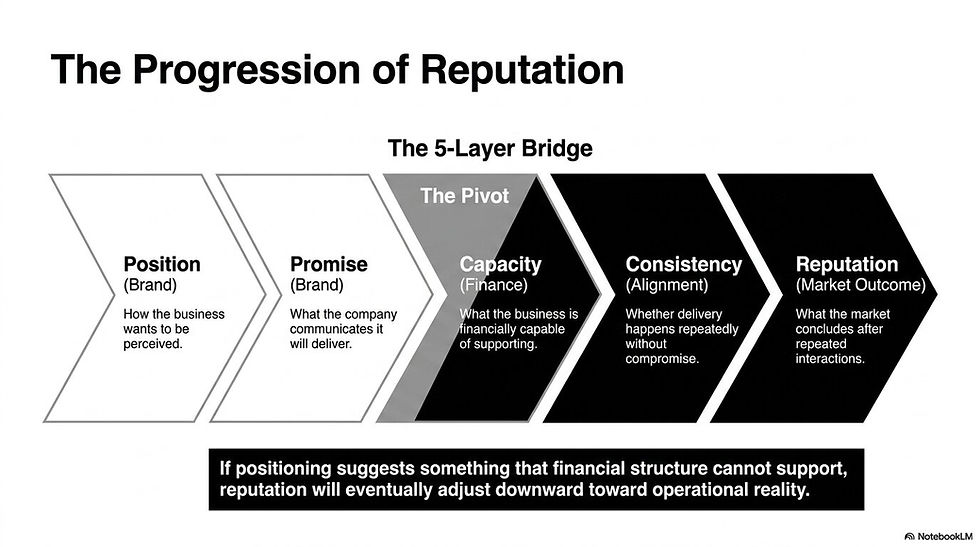
One useful way to understand this relationship is through a simple progression:
Position → Promise → Capacity → Consistency → Reputation
Position
How the business wants to be perceived.
Promise
What the company communicates it will deliver.
Capacity
What the business is financially and operationally capable of supporting.
Consistency
Whether the company can deliver repeatedly without compromise.
Reputation
What the market ultimately concludes after repeated interactions.
Most branding conversations focus on position and promise.
Most financial conversations focus on capacity.
But reputation forms through consistency, and consistency depends on the alignment of both systems.
If positioning suggests something that financial structure cannot support, the reputation will eventually adjust toward the operational reality.
Financial pressure eventually becomes visible
Leaders often assume financial stress remains behind the scenes.
In practice, it rarely does.
Financial pressure influences how companies behave:
pricing becomes reactive
client selection becomes less disciplined
strategic investments are delayed
quality becomes harder to maintain
communication becomes rushed
decisions become short-term
Over time, those behaviors change how the business feels to customers.
This is why brand deterioration often begins as financial strain.
What appears to be a branding issue — weaker perception, reduced trust, slower growth — may actually originate from deeper structural constraints within the business itself.
Strong financial design helps create stability, which leads to better decisions and more consistent brand experiences.

Premium perception requires economic support
Premium brands are not created by aesthetics alone.
They require economic discipline.
To deliver a premium experience consistently, businesses need:
healthy margins
sufficient working capital
strategic pricing
the ability to hire strong talent
room for service recovery
resources for continuous improvement
Without those elements, the brand promise becomes difficult to maintain.
This does not mean every business must pursue a premium position.
It simply means the financial structure must match the level of experience the company intends to deliver.
When brand ambition and financial reality are aligned, the business feels more stable, confident, and intentional.

Pricing is where finance and brand visibly intersect
Few decisions reveal the relationship between brand and finance more clearly than pricing.
Price communicates positioning.
It signals confidence, value, and market alignment.
Underpricing often weakens both financial performance and brand perception.
It reduces margins, limits reinvestment, and can attract customers who are less aligned with the intended positioning of the business.
Over time, that pressure makes it harder to maintain quality, responsiveness, and strategic focus.
Thoughtful pricing, on the other hand, supports both profitability and brand credibility.
It gives the company room to invest in systems, talent, and customer experience — the elements that sustain trust.

Tax strategy also shapes brand strength
Financial structure extends beyond pricing and margins.
Tax planning and strategic financial architecture influence how much capital a business can preserve, reinvest, and deploy toward growth.
This is where collaboration with experienced financial advisors becomes critical.
Professionals such as Hannah Adenikinju MBA of Jadeola Consulting help businesses navigate cross-border tax complexity, entity structure, and long-term planning across Canada and the United States.
Strategic tax planning does more than reduce liability.
It protects the resources needed to:
reinvest in brand development
improve operational systems
hire talent
expand services
build long-term resilience
When financial design is treated as a strategic discipline rather than a reactive exercise, the business gains flexibility and confidence.
And that confidence becomes visible in the brand.

Reinvestment is a branding decision
One of the most common mistakes business owners make is treating brand investment as optional.
Brand development is sometimes delayed until something clearly feels outdated or broken.
But brand is not just a cosmetic layer.
It influences:
trust
conversion
pricing power
recruiting
differentiation
market clarity
A neglected brand creates friction even when the underlying business is strong.
Customers struggle to understand the value.
Sales cycles become longer.
Opportunities are lost to competitors who communicate their capabilities more clearly.
This is why businesses should treat brand investment as a strategic asset rather than a marketing expense.
Strategic frameworks like the JAXONLABS Innovation Framework help organizations align their brand expression with operational and financial realities so growth can occur with clarity and consistency.
Businesses that design both their financial architecture and brand positioning intentionally are far better equipped to scale.

Questions business leaders should ask
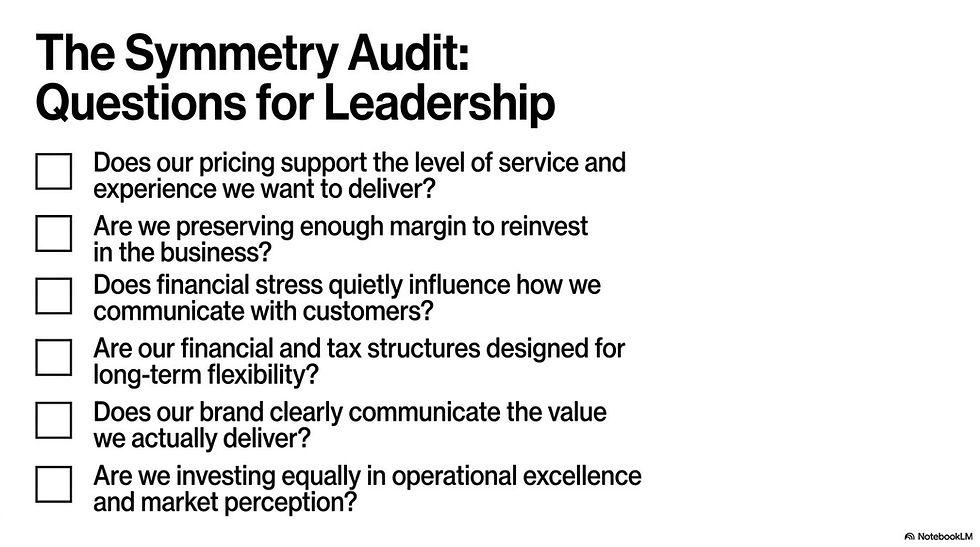
To evaluate whether brand and financial design are aligned, consider the following questions:
Does our pricing support the level of service and experience we want to deliver?
Are we preserving enough margin to reinvest in the business?
Does financial stress influence how we communicate with customers?
Are our financial and tax structures designed for long-term flexibility?
Does our brand clearly communicate the value we actually deliver?
Are we investing in both operational excellence and market perception?
These questions reveal whether the business is being designed as a unified system or as disconnected parts.
Strong businesses are designed from the inside out
The companies that build lasting trust rarely succeed through messaging alone.
They succeed because their internal structure supports the experience they promise externally.
Brand design shapes how the market sees a business.
Financial design shapes whether that perception holds up under pressure.
Business leaders who take both disciplines seriously build companies that feel more stable, more credible, and more capable of sustained growth.
Brand design and financial design are not competing priorities.
They are two halves of the same system.
And the businesses that understand this are the ones most likely to build reputations that last.


