
How to Create a Business Growth Plan That Actually Guides Decisions

Updated: Aug 29
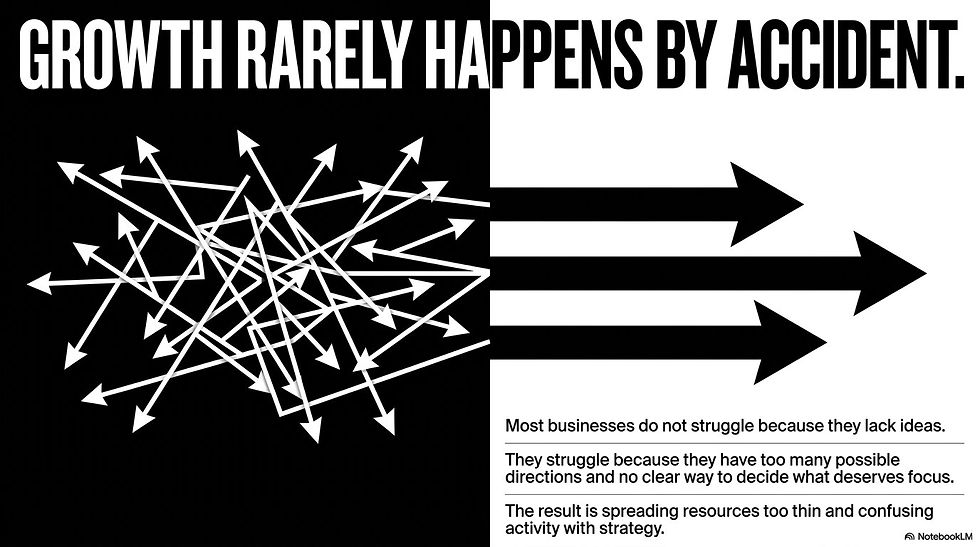
Growth rarely happens by accident.
Most businesses do not struggle because they lack ideas.
They struggle because they have too many possible directions and no clear way to decide what deserves focus.

A business growth plan helps leadership teams translate ambition into priorities, actions, owners, and measurable progress. It connects where the company wants to go with what the team must actually do next.
For founders, executives, and operators, growth planning is not about chasing every trend, tactic, or opportunity. It is about building a clear framework that helps the business make better decisions, allocate resources wisely, and move forward with more confidence.
This article walks through a practical business growth planning framework that can help you clarify your current position, identify the right opportunities, and build a plan that supports sustainable growth.
What Is a Business Growth Plan?
A business growth plan is a structured roadmap for how a company intends to grow over a defined period of time.
It outlines the company’s growth goals, target opportunities, strategic priorities, required resources, execution plan, and key performance indicators.
Unlike a general business plan, which often describes the entire company, a growth plan focuses specifically on how the business will expand.
That might include increasing revenue, entering new markets, improving customer retention, launching new offers, building partnerships, or strengthening operational capacity.
A strong business growth plan should answer a few essential questions:
Where are we now?
Where do we want to go?
What growth opportunities are most realistic?
What capabilities do we need to strengthen?
What priorities deserve our focus?
Who owns the work?
How will we measure progress?
Without this clarity, businesses can easily spread themselves too thin. They pursue too many ideas, invest in the wrong initiatives, or mistake activity for strategy.

Why Business Growth Planning Matters
Growth planning is more than setting ambitious revenue targets.
It is a disciplined process for aligning vision, market opportunity, internal capacity, and execution.
When done well, it helps a company focus its energy on the opportunities that are most likely to create meaningful progress.
A well-built growth plan can help your business:
Identify and prioritize the right opportunities
Allocate resources more effectively
Create alignment across leadership and teams
Avoid distractions that dilute focus
Anticipate risks before they become major problems
Measure progress using meaningful metrics
Adapt as market conditions change
For example, a company may want to expand into a new market. On the surface, that may seem like a growth opportunity. But a proper growth planning process would look deeper.
Does the company have enough operational capacity? Is there real demand in the new market? Are competitors already well-positioned? Does the company have the right sales, marketing, and delivery infrastructure to support expansion?
A growth plan helps answer these questions before the business commits time, capital, and team energy to the wrong path.
Business Growth Plan vs. Business Development Strategy
A business growth plan and a business development strategy are related, but they are not the same thing.
A business growth plan defines the broader path for company growth. It looks at the full picture, including goals, resources, priorities, operations, marketing, sales, partnerships, and performance measurement.
A business development strategy focuses more specifically on identifying and pursuing external opportunities that support growth. These opportunities may include partnerships, referral relationships, new markets, strategic accounts, or new revenue channels.

For example, a professional services firm might set a goal to increase revenue by 30% over the next 18 months.
The business growth plan would define the overall path to that goal. It might include improving positioning, refining service packages, strengthening the website, building a referral system, improving sales follow-up, and creating stronger operational processes.
The business development strategy would focus on the external relationships and opportunities that help support that plan, such as strategic alliances, partnership channels, industry networking, or targeted account development.
Both are important. The growth plan creates the larger direction. The business development strategy supports that direction by creating new opportunities.
The JAXONLABS Business Growth Planning Framework
At JAXONLABS, we believe growth planning should function as a decision-making system.
It should help a leadership team understand where the business is, where it can go, what deserves focus, and how progress will be measured.
A practical business growth planning framework includes five core parts:
Current position
Growth direction
Strategic priorities
Execution plan
Measurement and review
Each part plays an important role in turning ambition into action.
1. Understand Your Current Position
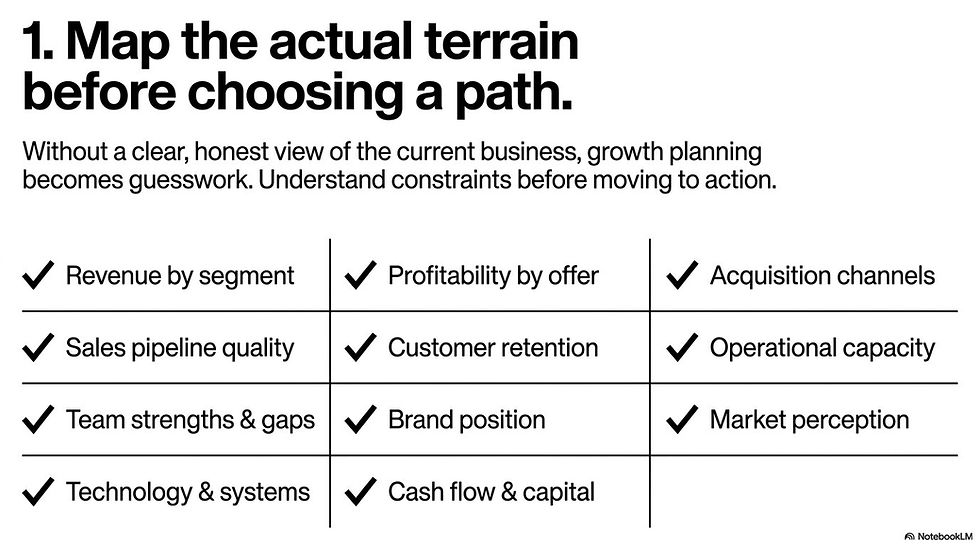
Before choosing a growth path, a company needs to understand where it actually stands.
This step is often skipped because leadership teams are eager to move into ideas and action. But without a clear view of the current business, growth planning becomes guesswork.
Start by reviewing the fundamentals:
Revenue by product, service, or customer segment
Profitability by offer or client type
Customer acquisition channels
Sales pipeline quality
Customer retention and repeat purchase behaviour
Operational capacity
Team strengths and gaps
Brand position
Market perception
Technology and systems
Cash flow and available capital
The goal is to understand what is already working, what is underperforming, and what constraints may limit growth.
For example, a business may believe it needs more leads. But after reviewing the current position, it may discover that the real issue is not lead generation.
The issue may be poor conversion, unclear positioning, weak follow-up, or an offer that is not packaged clearly.
A strong growth plan starts with an honest assessment of reality.
2. Choose the Right Growth Direction
Once the current position is clear, the next step is deciding what kind of growth makes the most sense.
Not all growth is equal. Some growth creates stronger margins, better customers, and long-term stability. Other growth creates complexity, operational pressure, or low-profit activity.
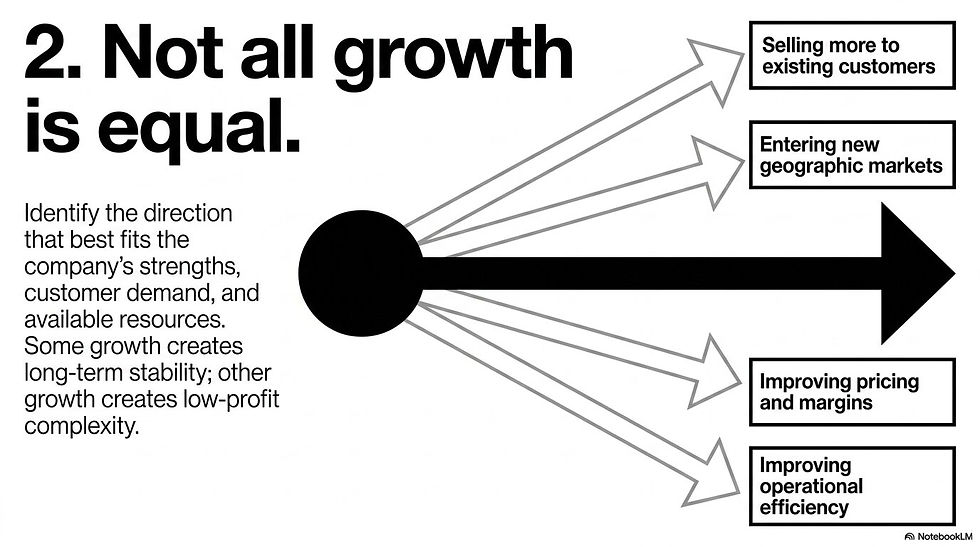
Common growth directions include:
Selling more to existing customers
Attracting new customers in the same market
Entering a new geographic market
Building a new offer, service, or product line
Increasing customer retention
Improving pricing and margins
Creating strategic partnerships
Expanding through acquisition
Building stronger digital marketing and sales systems
Improving operational efficiency to increase capacity
The key is not to pursue every path. The key is to identify the growth direction that best fits the company’s strengths, market opportunity, customer demand, and available resources.
A company with strong customer relationships may find its best growth path through retention, referrals, and account expansion.
A company with a strong product but weak market awareness may need to focus on positioning, content, advertising, and sales enablement.
A company with high demand but delivery bottlenecks may need to focus on systems, operations, hiring, and process improvement before pushing harder on sales.
Growth planning should help the company choose the path that creates the most strategic value, not just the most activity.
3. Define Strategic Priorities
After choosing the growth direction, the business needs to define its strategic priorities.
Strategic priorities are the few major areas of focus that will move the company toward its growth goals. They help leadership and teams understand what matters most.

For most businesses, three to five strategic priorities is enough.
Examples of strategic priorities include:
Improve lead generation quality
Increase conversion from inquiry to sale
Strengthen customer retention
Launch a new high-margin service
Build a stronger referral system
Improve brand clarity in a crowded market
Expand into a specific customer segment
Increase operational capacity
Improve pricing strategy
Build better reporting and performance visibility
This is where many companies go wrong. They create a long list of initiatives, but they do not make hard choices.
A growth plan should create focus. It should help the business decide what to pursue, what to delay, and what to ignore.
Strong strategic priorities should meet five criteria:
They support the larger growth goal
They are realistic based on current resources
They create meaningful business impact
They can be translated into action
They can be measured
If a priority does not meet these criteria, it may be an idea worth discussing, but it should not become part of the growth plan yet.
4. Build the Execution Plan
A growth plan only becomes valuable when it turns into action.
Once the strategic priorities are clear, each priority needs an execution plan. This is where strategy becomes practical.

For each priority, define:
What needs to happen
Who owns the work
What resources are required
What the timeline looks like
What dependencies exist
What risks need to be managed
What success looks like
For example, a company may identify “improve lead quality” as a strategic priority.
The execution plan might include:
Refine positioning and messaging
Update website copy and calls to action
Improve the contact form or qualification process
Create new case studies
Build a targeted outreach list
Test LinkedIn content around specific customer problems
Review sales calls to identify common objections
Each of these actions should have an owner, timeline, and expected outcome.
This prevents the growth plan from becoming a vague strategy document that sounds good but never changes how the business operates.
5. Measure, Review, and Adapt
A business growth plan should not sit in a document for 12 months.
It should be reviewed regularly using a focused set of meaningful key performance indicators.

Depending on the business, useful KPIs may include:
Revenue growth
Gross margin
Net profit
Customer acquisition cost
Customer lifetime value
Lead-to-sale conversion rate
Proposal close rate
Average deal size
Repeat purchase rate
Customer retention
Churn rate
Sales cycle length
Website conversion rate
Qualified inquiries
Operational capacity
Cash flow
The goal is not to track everything. The goal is to track the numbers that show whether the growth plan is working.
A monthly or quarterly review rhythm helps the leadership team ask better questions:
What is working?
What is not working?
What have we learned?
What should we stop doing?
What needs more investment?
What needs to change?
Are we still focused on the right priorities?
This review process allows the business to adapt without losing direction.
A strong growth plan provides structure, but it should not be rigid. Markets shift, customers change, competitors move, and internal capacity evolves.
The plan should help the business stay focused while still learning from reality.
How to Create a Business Growth Plan Step by Step
A practical business growth plan does not need to be complicated. It needs to be clear, focused, and useful.
Here is a step-by-step process you can use.
Step 1: Define the Growth Goal
Start with a clear and measurable growth goal.
A weak goal sounds like this:
“We want to grow the business.”
A stronger goal sounds like this:
“We want to increase revenue by 25% over the next 12 months while maintaining gross margin above 40%.”
The second goal is better because it creates direction and constraints. It defines what growth means and adds a profitability expectation.
Depending on the business, your growth goal may focus on revenue, profit, market share, customer retention, geographic expansion, sales pipeline growth, or operational capacity.
The more specific the goal, the easier it becomes to build a useful plan around it.
Step 2: Identify Your Best Growth Opportunities
Next, identify the most realistic growth opportunities available to the business.
Ask questions like:
Which customer segments are most profitable?
Which offers have the strongest demand?
Where do we already have momentum?
Which channels are producing qualified leads?
What customer problems are becoming more urgent?
What parts of the market are underserved?
What capabilities do we already have that could be used more effectively?
Where are competitors weak?
What do existing customers already trust us to do?
This step helps the business avoid chasing opportunities that look exciting but do not fit the company’s strengths.
The best growth opportunities usually sit at the intersection of customer demand, business capability, profitability, and strategic fit.
Step 3: Evaluate Internal Capacity
Growth creates pressure.
Before committing to a growth plan, assess whether the business has the capacity to support it.
Look at:
Team capacity
Leadership bandwidth
Systems and processes
Technology
Cash flow
Delivery capability
Sales and marketing infrastructure
Customer support
Operational bottlenecks
This is important because growth can expose weaknesses inside the business.
If a company increases demand but does not have the systems, people, or processes to deliver well, growth can damage the customer experience and strain the team.
A realistic growth plan considers what the business must strengthen before, during, and after growth.
Step 4: Choose Your Strategic Priorities
Once the growth goal, opportunities, and capacity are clear, choose the strategic priorities that deserve focus.
A good filter is:
Does this priority support the growth goal?
Is it realistic with our current resources?
Does it build long-term advantage?
Can we measure progress?
Will it improve focus across the company?
For example, if a company wants to grow revenue but has a weak sales process, improving sales conversion may matter more than increasing advertising spend.
If a company has strong demand but weak delivery capacity, operational improvement may be the most important growth priority.
If a company has a great offer but unclear messaging, brand positioning and website strategy may need to come first.
The right priorities depend on the actual business context.
Step 5: Build the Action Roadmap
The action roadmap turns priorities into execution.
For each strategic priority, define the specific initiatives, owners, timelines, and success measures.
Here is a simple example:
Strategic Priority: Improve lead quality
Actions:
Refine positioning
Update website messaging
Improve qualification form
Create two new case studies
Build a targeted outreach list
Test LinkedIn content around specific buyer problems
Owner: Marketing lead or leadership team
Timeline: 90 days
KPIs:
Qualified inquiries
Lead-to-sale conversion rate
Sales call quality
Proposal close rate
Average deal size
This level of detail helps the team understand what needs to happen and how progress will be evaluated.
Step 6: Set a Review Rhythm
Growth planning is not a one-time exercise.
Set a review rhythm so the plan stays active.
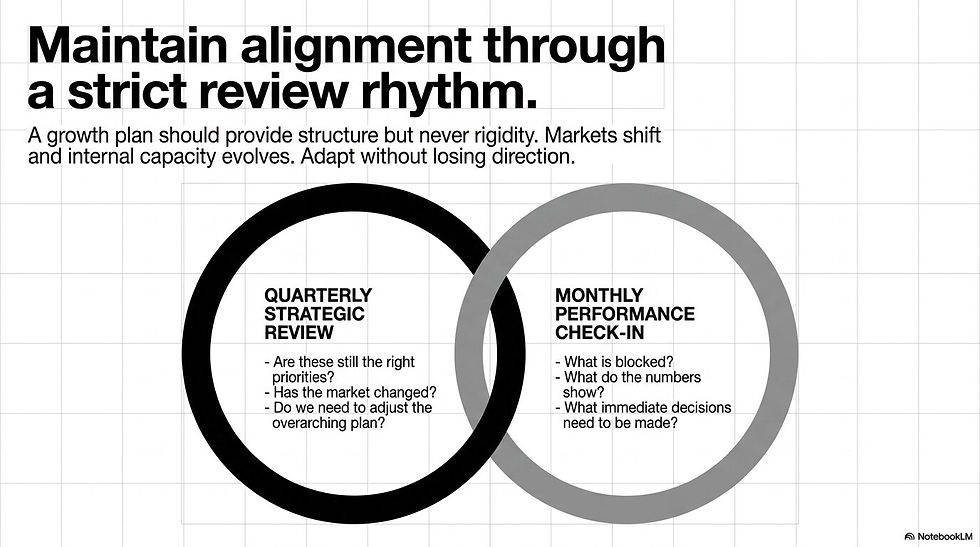
For many businesses, a quarterly strategic review and a monthly performance check-in works well.
The quarterly review can focus on larger questions:
Are these still the right priorities?
Has the market changed?
Are we seeing the progress we expected?
Do we need to adjust the plan?
The monthly check-in can focus on execution:
What was completed?
What is behind?
What is blocked?
What do the numbers show?
What decisions need to be made?
This rhythm keeps the plan connected to real business activity.
Common Mistakes in Business Growth Planning
Even strong companies can struggle with growth planning when the process becomes too broad, too vague, or too disconnected from execution.
Here are some common mistakes to avoid.

Mistake 1: Confusing Activity With Strategy
More marketing, more sales calls, more meetings, or more content does not automatically mean better growth.
Activity only matters when it supports a clear strategic priority.
A growth plan should clarify which activities matter most and why.
Mistake 2: Setting Goals Without Choosing Tradeoffs
Every strategy requires tradeoffs.
If a company says yes to every opportunity, it usually weakens execution across all of them.
A good growth plan helps leadership decide what not to do.
Mistake 3: Ignoring Operational Capacity
Sales growth can hurt a business if delivery, staffing, systems, or cash flow cannot keep up.
Before pushing for growth, the business needs to understand whether it can support that growth without damaging quality, culture, or customer experience.
Mistake 4: Tracking Too Many KPIs
Too many metrics create noise.
The better approach is to choose a small number of indicators that connect directly to the company’s growth priorities.
The right KPIs should help the business make decisions, not just fill a dashboard.
Mistake 5: Treating the Plan as Fixed
A growth plan should provide direction, but it should also leave room for learning.
Markets change. Customers change. Internal capacity changes.
The plan should be reviewed and adjusted as new information becomes available.
Example of a Business Growth Plan in Practice
Imagine a mid-sized service business that wants to grow revenue by 20% over the next year.
At first, the leadership team believes it needs more leads. But after reviewing the business, they discover a different problem.
The company already has referral activity and website traffic, but its positioning is unclear, its inquiry process is weak, and its follow-up is inconsistent.
Instead of immediately spending more money on advertising, the company chooses three strategic priorities:
Clarify the positioning of its highest-value service
Improve the website and inquiry process
Build a structured follow-up and referral system
The action plan includes rewriting key website pages, creating stronger case studies, improving the contact form, building a follow-up sequence, and identifying referral partners.
The team tracks qualified inquiries, proposal conversion rate, average deal size, and revenue from repeat clients.
This is what makes the growth plan useful. It connects the growth goal to specific actions, owners, and measurements.
The Role of Systems Thinking in Growth Planning
Growth does not happen in isolation.
Marketing affects sales. Sales affects operations. Operations affects customer experience. Customer experience affects retention, referrals, and reputation.
Systems thinking helps leadership teams see how different parts of the business connect.

For example, if a company wants to improve customer acquisition, the solution may not only be better marketing. It may also require clearer positioning, stronger offers, better sales follow-up, improved onboarding, and a more consistent customer experience.
By looking at the business as a system, leaders can identify the real leverage points.
This is where growth planning becomes more than a list of initiatives. It becomes a way to understand how the business actually creates value.
When to Bring in Outside Support
A business growth plan can be created internally, but outside support can be valuable when the leadership team is too close to the business.
An outside advisor can help clarify:
Where the business has the strongest growth opportunity
Which priorities deserve focus
Which ideas are distractions
Where the brand, sales, marketing, and operations are misaligned
What systems need to be built before scaling
How to turn strategic thinking into an actionable roadmap
This is especially useful when a company has momentum but lacks clarity.
Many businesses reach a stage where they are not starting from zero, but they are also not operating with the focus, systems, or strategic alignment needed for the next stage of growth.
That is often where structured growth planning creates the most value.
Business Growth Planning FAQ
What is included in a business growth plan?
A business growth plan usually includes growth goals, market analysis, strategic priorities, resource requirements, action plans, timelines, owners, KPIs, and review cycles.
The purpose is to create a clear roadmap for how the business will grow and how progress will be measured.
How is a growth plan different from a business plan?
A business plan describes the overall company, including its model, market, operations, finances, and structure.
A growth plan focuses specifically on how the business will expand, improve revenue, increase profitability, strengthen market position, or build capacity.
What are the main types of business growth strategies?
Common business growth strategies include market penetration, market expansion, product or service expansion, customer retention, strategic partnerships, pricing improvements, operational scaling, and acquisition.
The right strategy depends on the company’s goals, resources, customers, and market conditions.
How often should a business growth plan be reviewed?
Most companies should review their growth plan monthly or quarterly.
Monthly reviews are useful for tracking execution and performance. Quarterly reviews are useful for evaluating larger strategic priorities and making adjustments.
Why do business growth plans fail?
Business growth plans often fail because they are too broad, disconnected from resources, poorly measured, or not translated into clear ownership and execution.
A plan is only useful if it helps the business make better decisions and take focused action.
Growth Planning Is a Decision-Making System
A strong business growth plan is not just a document. It is a decision-making system.
It helps leaders choose where to focus, how to allocate resources, what to measure, and when to adapt.

The companies that grow well are not always the ones with the most ideas. They are often the ones with the clearest priorities, the strongest alignment, and the discipline to review what is actually working.
For companies navigating complexity, growth planning provides the structure to move forward with more confidence, less noise, and better strategic focus.
Need Help Clarifying Your Next Stage of Growth?
JAXONLABS helps leadership teams turn scattered ideas into focused growth plans, strategic priorities, and practical execution roadmaps.
If your business has momentum but needs clearer direction, we can help you identify what matters most and build a plan around it.


