
The Strategy-to-Execution Gap: Why Good Ideas Fail to Become Growth

Most strategies do not fail because they are wrong.
They fail because they never become a working system.
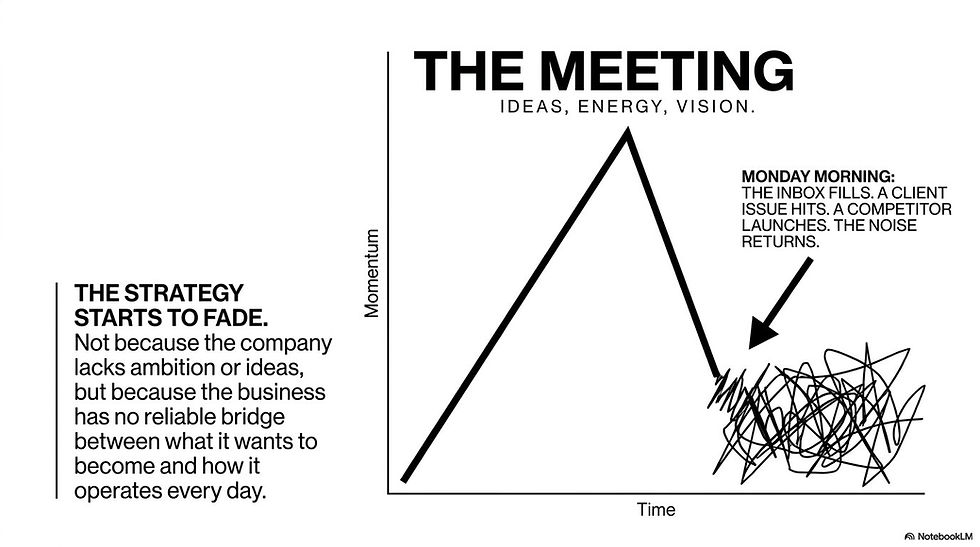
They sound good in the meeting. They look sharp in the deck. They create energy when the leadership team is sitting around the table, imagining what the business could become.
Then Monday arrives.
The inbox fills up. A client issue takes over the morning. A sales opportunity appears. Someone asks whether the website should be updated. Someone else wants to test a new AI tool. A customer complaint exposes an operational gap. A competitor launches something that suddenly feels urgent.
Within days, the strategy starts to fade.
Not because people stopped caring. Not because the ideas were bad. Not because the company lacked ambition.

The strategy fades because the business has no reliable bridge between what it wants to become and how it operates every day.
That bridge is where growth is either created or lost.
This is the strategy-to-execution gap.
And for many growing businesses, it is one of the biggest reasons good ideas fail to become real momentum.
The Problem Is Rarely a Lack of Ideas
Ambitious companies usually have more ideas than they can responsibly execute.
The founder has ideas. Sales has ideas from customer conversations. Marketing has campaign ideas. Operations sees process improvements. Customers reveal unmet needs. Competitors create pressure. Technology opens new possibilities.
AI adds another layer of opportunity and distraction.
At a certain point, more ideas do not create more growth.
They create more noise.
The real question becomes: which idea deserves the company’s limited attention right now?
That is where strategy earns its keep.
Strategy is not a list of things the company could do. It is the discipline of deciding what matters most, why it matters, and how the organization will concentrate its effort to create a specific outcome.
The value of strategy is not in producing more possibilities. It is in helping the business make better decisions with limited time, money, attention, and energy.
If strategy does not help the company decide what to do and what not to do, it is not yet useful enough.

Why Strategy Fails After the Meeting Ends
There is a familiar pattern inside many businesses.
A leadership team steps back to discuss growth. They talk about positioning, revenue, customer experience, marketing, hiring, systems, technology, and operations. They identify real issues. They agree on several priorities. Everyone leaves with a sense that the conversation was valuable.
Then a few weeks pass.
The same problems remain. The same conversations repeat. The same bottlenecks slow progress down. The same people carry too much of the responsibility. The same unclear priorities create friction.
This usually does not happen because people are lazy.
It happens because the strategy never crossed the line from conversation to operating system.
There are five common reasons this happens.
1. The Strategy Is Too Abstract
A strategy can be directionally correct and still be too vague to execute.
Phrases like “improve brand awareness,” “build a better customer experience,” “become more efficient,” “use AI,” “grow revenue,” or “differentiate in the market” may all be valid. But they are not specific enough to guide action on their own.
A team cannot execute against a foggy idea.
They need to know what the priority means in practical terms.
What part of the customer experience needs improvement? Which market segment matters most? Where would AI actually reduce friction or increase leverage? What would meaningful differentiation look like in the eyes of the buyer?
Abstract strategy creates the illusion of alignment. Everyone nods along because the words sound right. But once people return to their own roles, they interpret the strategy differently.
One person thinks the priority is a new website. Another thinks it is better sales collateral. Another thinks it is internal process improvement. Another thinks it is content. Another thinks it is automation.
Now the company is not executing one strategy.
It is executing several interpretations of the same vague idea.
That is where momentum starts to fragment.
A useful strategy should reduce interpretation. It should make the next best moves easier to see.
2. There Are Too Many Priorities
A business can only move so many things forward at once.
This is especially true for small and mid-sized companies where the same people often carry strategy, sales, operations, client service, and execution.
When everything is a priority, the team does not become more productive. It becomes more scattered.
The company starts a website refresh, a content plan, a sales push, a new internal system, an AI experiment, a hiring process, a brand update, and a customer retention initiative all at the same time.
Each one may be valuable. Together, they compete for the same limited resources.
The result is predictable: lots of motion, not enough completion.
This is one of the most expensive forms of inefficiency in a growing business. It does not always show up as a clear line item. It shows up as delays, half-finished initiatives, unclear accountability, team fatigue, and missed opportunities.
Strategic growth requires sequencing.
Not every good idea deserves to happen now.
Some ideas are foundational. Some are accelerators. Some are distractions. Some are only valuable after another problem has been solved.
The discipline to delay a good idea is often just as important as the ability to act on one.
3. Ownership Is Unclear
Many strategic initiatives fail because everyone agrees they matter, but no one truly owns them.
A priority is discussed. The team supports it. A few next steps are mentioned. Then the meeting ends.
But who is responsible?
Who has the authority to make decisions? Who is gathering the information? Who is moving the work forward? Who is checking progress? Who is accountable if nothing happens?
Without ownership, strategy becomes a shared intention instead of a managed commitment.
This is especially dangerous in collaborative teams. When everyone is involved, it can feel like the work is covered. But involvement is not the same as accountability.
Every meaningful initiative needs a clear owner.
That does not mean one person does all the work. It means one person is responsible for making sure the work advances.
They coordinate input. They clarify decisions. They identify blockers. They report progress. They make sure the initiative does not quietly disappear under day-to-day demands.
Ownership turns strategy from something the company hopes will happen into something someone is actively driving.
4. There Is No Operating Rhythm
Even when priorities are clear and ownership is assigned, execution can still break down if there is no rhythm for review.
Businesses often underestimate how much repetition is required to execute well.
A strategy cannot be mentioned once and then trusted to carry itself.
It needs cadence.
Weekly check-ins. Monthly reviews. Quarterly resets. Clear metrics. Clear decisions. Clear adjustments.
The point is not to create more meetings. The point is to create a management system that keeps the business honest.
A good operating rhythm creates a recurring space to ask: are we still focused on the right priorities, what progress has been made, what is blocked, what decision needs to be made, and what needs to change?
Without a rhythm, strategy becomes memory.
With a rhythm, strategy becomes behavior.
5. The Business Measures Activity Instead of Progress
A company can be very active and still not be making strategic progress.
More posts. More meetings. More campaigns. More tools. More documents. More calls. More tasks.
Activity feels productive because it is visible. But visibility is not the same as value.
The better question is: what is actually changing because of the work?
Is the company becoming easier to understand? Are better leads coming in? Is the sales process improving? Are customers moving faster from interest to decision? Are internal bottlenecks being reduced? Are leaders making better decisions?
Strategic execution needs measurement, but not just any measurement.
The business needs to measure the indicators that connect to the outcome it is trying to create.

For a brand strategy initiative, that may mean stronger message clarity, better website conversion, improved sales conversations, more qualified inquiries, or higher trust during the buying process.
For an operational initiative, it may mean reduced manual work, faster turnaround time, fewer errors, cleaner handoffs, or improved visibility across the team.
For a growth initiative, it may mean better pipeline quality, stronger close rates, larger average deal size, improved retention, more referrals, or expansion into a more valuable market.
The right metrics depend on the strategy.
But the principle stays the same: if the company only measures effort, it may miss whether the effort is actually producing movement.
Strategy Is Not a Document. It Is an Operating System.
This is the shift many businesses need to make.
Strategy should not live only in a deck, a document, a whiteboard, or a leadership conversation.
Strategy should shape how the company operates.
It should influence what gets prioritized, what gets funded, what gets ignored, what gets measured, what gets delegated, what gets automated, what gets improved, and what gets communicated.
A strategy becomes valuable when it changes the behavior of the business.
That means it needs to become part of the company’s operating system.
An operating system is not just a plan. It is the structure that helps people make decisions and take action consistently.

For a business, that operating system includes direction, priorities, ownership, systems, review, metrics, and communication habits.
This is where strategy becomes practical.
The goal is not to make strategy more theoretical. The goal is to make it more usable.
A usable strategy helps a leader decide what to say no to. It helps a team understand what matters this quarter. It helps marketing know what message to reinforce.
It helps sales know which customers to pursue. It helps operations know what process needs improvement. It helps leadership know where to allocate resources.
Most importantly, it helps the business move with more intention and less noise.
A Practical Framework for Closing the Strategy-to-Execution Gap
Closing the gap does not require a massive corporate planning process.
Most growing businesses need something simpler, sharper, and more useful.
A practical strategy-to-execution system can be built around five elements:
Direction
Priorities
Ownership
Systems
Review
Together, these elements create the bridge between ambition and execution.

1. Direction: Where Are We Going?
Direction answers the big question.
What is the business trying to become?
This does not need to be an overcomplicated vision statement. It needs to be clear enough to guide decisions.
A strong direction gives the company a sense of orientation. It helps leaders judge opportunities based on whether they move the business toward the intended future.
That future may involve becoming the premium option in a category, expanding into a new market, improving profitability before chasing more revenue, repositioning for a different type of buyer, or using technology to increase capacity without adding unnecessary complexity.
The specific direction will vary by company.
The need for direction does not.
Without direction, every opportunity looks equally valid.
With direction, the company has a filter.
2. Priorities: What Matters Most Now?
Once direction is clear, the business needs to identify the few priorities that matter most in the current stage.
This is where discipline matters.
A priority is not just something important. Many things are important.
A true priority is something that deserves concentrated attention now because it has the potential to unlock meaningful progress.
For one company, the next priority may be clarifying its market position. For another, it may be rebuilding the website so prospects finally understand the offer.
For others, the unlock may be stronger sales follow-up, better internal documentation, AI-enabled administrative relief, or a management rhythm that stops the leadership team from operating reactively.
The point is not that every company needs the same plan. The point is that every company needs the discipline to identify the constraint that matters most right now.
A useful question is:
If we could only make serious progress on three things over the next 90 days,
what would create the greatest improvement in the business?
That question forces focus.
And focus is what turns strategic conversation into strategic movement.
3. Ownership: Who Is Responsible?
Every priority needs an owner.
Not a vague group. Not “the team.” Not “leadership.” A person.
The owner is responsible for moving the priority forward.
They do not need to have all the answers. They do not need to do every task. But they do need to hold the thread.
This is where many businesses create unnecessary drag. They assign work casually, without defining what ownership actually means.
Good ownership should make the practical terms clear: what authority the owner has, who else needs to contribute, what resources are available, what success looks like, when progress will be reviewed, and what happens if the priority gets blocked.
Clear ownership reduces confusion. It also reduces the leadership burden, because the founder or executive team does not have to personally carry every initiative.
Growth requires distributed accountability.
If every strategic priority depends on one person pushing it forward, the business does not just have a strategy problem. It has a capacity problem.
4. Systems: What Repeatable Process Supports the Work?
A strategy becomes stronger when it is supported by systems.
Systems are the repeatable processes, tools, workflows, templates, habits, and decision rules that make execution easier.
A sales strategy needs a sales process. A content strategy needs a production workflow. A customer experience strategy needs service standards and feedback loops.
An AI strategy needs clear use cases and workflow integration. A brand development strategy needs messaging guidelines, website alignment, sales materials, and consistent communication.
The pattern is simple: if the strategy matters, it needs a structure that helps people execute it repeatedly.
Without systems, the business relies too heavily on individual effort.
That may work for a while. But as the company grows, effort alone becomes unreliable.
People get busy. Information gets trapped. Standards drift. Work gets repeated. Mistakes become normal. The business starts depending on memory instead of process.
Systems reduce that dependency.
They help the company execute with more consistency.
They also create a foundation for scale.
The point is not to systematize everything to death. Too much process can slow a company down.
The point is to systematize the areas where inconsistency is costing the business time, money, quality, clarity, or growth.
5. Review: How Do We Know If It Is Working?
The final piece is review.
Strategy needs feedback.
A company should not blindly follow a plan just because it sounded good three months ago. Markets shift. Customers respond. Internal constraints appear. New information emerges.
Review is where the business learns.
It is where leaders compare intention against reality.
What did we expect to happen? What actually happened? What did we learn? What should we continue? What should we change? What should we stop?
The best companies do not treat strategy as fixed. They treat it as directional, disciplined, and responsive.
They stay committed to the outcome, but flexible in how they get there.
That is the difference between strategic execution and rigid planning.
Rigid planning says, “We made the plan, so follow it.”
Strategic execution says, “We know where we are going, so let’s keep learning and adjusting as we move.”
Where Brand, Marketing, AI, and Operations Fit
One of the reasons execution becomes difficult is that business problems rarely stay in one category.
A sales problem might actually be a positioning problem.
A marketing problem might be an offer clarity problem.
An operations problem might be a leadership rhythm problem.
An AI opportunity might be blocked by messy processes.

A website and digital experience problem might be connected to unclear messaging, weak proof, poor user experience, or a lack of strategic focus.
This is why businesses can waste a lot of money solving the visible symptom instead of the underlying issue.
They run ads when the offer is unclear. They redesign the website when the positioning is weak. They hire more people when the process is broken. They buy software before defining the workflow. They create content before knowing what they need to be known for. They chase AI tools before understanding where the business actually needs leverage.
Strategy helps connect the pieces.
Brand clarifies what the company stands for, who it serves, why it matters, and how it should be understood.
Marketing turns that clarity into demand, trust, attention, and conversion.
Sales turns interest into committed customers.
Operations delivers the promise.
Technology, automation, and AI improve speed, capacity, insight, and consistency when applied to the right problems.
Leadership keeps the system aligned.
When these pieces are disconnected, the business feels harder to manage than it should.
When they are aligned, growth becomes more intentional.
The Cost of the Gap
The strategy-to-execution gap is expensive, even when it is not obvious.
It shows up in ways that many businesses normalize.
Projects take longer than expected. Marketing feels inconsistent. The website does not reflect the company’s real value. Sales conversations depend too much on the founder. The team is busy but unclear. Decisions get revisited repeatedly.
Good ideas are started and abandoned. New tools are adopted without changing results. Leaders feel like they are constantly re-explaining the same things.
None of these issues may feel catastrophic on their own.
But together, they create drag.
And drag compounds.
A business does not need to be broken to be underperforming. Sometimes it is simply misaligned.
It has talent, ideas, customers, opportunities, and ambition. But the pieces are not working together cleanly enough.
That is where better strategy-to-execution alignment can create a major shift.

What Leaders Should Do Next
If you are leading a growing business, the starting point is not to ask, “Do we need more ideas?”
The better question is:
Where are our best ideas getting stuck?
Are they getting stuck because the direction is unclear?
Because there are too many priorities?
Because ownership is vague?
Because there is no system to support execution?
Because nobody is reviewing progress consistently?
Because the team is measuring activity instead of outcomes?
Because the brand, marketing, sales, operations, and technology pieces are not aligned?
Once you identify where the breakdown is happening, the solution becomes much more practical.
You may not need a complete reinvention.
You may need a clearer strategic filter.
You may need a sharper 90-day priority plan, supported by a clearer Strategic Growth Blueprint.
You may need better ownership.
You may need a simple operating rhythm.
You may need stronger messaging.
You may need to fix the customer journey.
You may need to turn a repeated manual process into a system.
You may need to stop chasing disconnected initiatives and build the foundation properly.
Growth usually does not come from doing more of everything.
It comes from doing the right things in the right order with enough consistency to create momentum.
Closing Thought
A good strategy should not end when the meeting ends.
That is where it should begin.
The real test of strategy is not whether it sounds intelligent. The real test is whether it changes how the business makes decisions, allocates resources, communicates value, serves customers, and measures progress.
Ideas matter.
Clarity matters.
Vision matters.
But none of them create growth unless they become action.
And action becomes growth when it is focused, owned, systemized, and reviewed.
That is how businesses close the strategy-to-execution gap.
That is how good ideas become measurable progress.
And that is how strategy becomes more than a document.
It becomes the way the business moves.
Turn Strategy Into a Working Growth System
If your business has strong ideas but lacks the structure to turn them into consistent progress, JAXONLABS can help you identify where strategy is breaking down and build a clearer path forward.
Through strategic planning, brand positioning, growth systems, and advisory support, we help leaders connect ambition to execution.
Start with a Strategic Growth Blueprint or book an introductory conversation to clarify where your next stage of growth should focus.


