
When Sales Problems Are Actually Brand Problems: Why Your Brand May Be Slowing Down Revenue

Updated: Aug 29
Your sales team may not have a sales problem.
They may have a brand problem.
If every sales conversation starts with explaining what your company does, who you help, why you are different, and why the problem matters, your sales team is being forced to create clarity in real time.
That makes every deal harder than it needs to be.

Strong salespeople can overcome unclear positioning for a while. They can explain, adapt, persuade, build trust, handle objections, and translate the business into language the prospect understands.
But that does not scale.
Eventually, the company needs the brand to do more of the work before the meeting ever happens.
A good brand does not replace sales. It prepares the buyer for a better sales conversation.
It helps prospects understand the problem, recognize the stakes, trust the company, and decide whether the conversation is worth having. When that work is missing, sales becomes slower, heavier, and more dependent on individual talent.

That is why some companies do not need more sales pressure.
They need clearer positioning, better messaging, stronger proof, and a brand system that helps the market understand them before the first call.
The sales call starts before the sales call
Most buyers do not begin their decision-making process when they speak to a salesperson.
They begin earlier.
They notice a problem. They hear about a solution. They search online. They ask peers. They compare vendors. They look at websites, case studies, articles, reviews, LinkedIn profiles, videos, and internal recommendations.
By the time they book a meeting, they have usually formed a rough impression of your company.
Sometimes that impression is clear.
Often, it is not.
Gartner describes the modern B2B buying journey as a nonlinear process where buyers move through jobs such as problem identification, solution exploration, requirements building, and supplier selection across both digital and human interactions.
In plain English, buyers are doing a lot of thinking before and around the sales process, not just during it.
Forrester has also pointed to the continued rise of digital self-service in B2B buying, predicting that more than half of large B2B transactions of $1 million or greater would be processed through digital self-serve channels in 2025.

That does not mean sales becomes irrelevant. It means the digital environment surrounding the sale has to carry more weight.
Your website, content, positioning, proof, and market presence are now part of the sales conversation before your team enters the room.
That creates a simple but uncomfortable question:
Is your brand preparing buyers for sales, or is it making sales start from zero?
Brand is not just visibility. It is buyer preparation.
Many companies still treat brand as a visibility function.
They think brand is how the company looks. The logo. The colors. The tagline. The social posts. The website design.
Those things matter, but they are not the whole job.
In a revenue context, brand has a much more practical responsibility.
Brand helps buyers understand:
What problem you solve
Who you are built to help
Why the problem matters
What makes your approach different
Why your company can be trusted
What action they should take next
That is not decoration. That is sales preparation.
When the brand does this well, prospects arrive with better context. They understand the company faster. They ask sharper questions. They are more likely to see the relevance of the offer. They have an easier time explaining the company to other decision-makers.
When the brand does this poorly, the sales team has to create all of that clarity manually.
That is where sales problems often begin.
A salesperson may be dealing with weak leads, long sales cycles, price objections, confused prospects, or inconsistent close rates. But the root issue may not be the salesperson’s skill.
The root issue may be that the buyer does not understand enough before the call.
Signs your sales problem may actually be a brand problem
Not every sales issue is caused by brand. Sometimes the problem is poor outreach, weak qualification, bad follow-up, lack of discipline, poor training, or a weak offer.
But in many companies, brand problems show up inside the sales process.
Here are the warning signs.

1. Prospects do not understand what you do before the call
If buyers arrive interested but confused, your sales team has to spend the first part of every conversation explaining the basics.
That means your website, content, referrals, and market presence are creating interest without enough clarity.
Interest is useful.
Interest with confusion is expensive.
2. Your team keeps explaining the same thing over and over
If your sales team has to repeat the same foundational explanation in every meeting, that explanation probably belongs in your brand messaging, website copy, service pages, sales collateral, or content system.
Sales should deepen understanding.
It should not have to create the first layer of understanding from scratch every time.
3. Buyers compare you to the wrong competitors
This is one of the clearest signs of weak positioning.
When prospects compare you to companies that solve a different problem, serve a different buyer, or operate at a different level of value, the market does not understand where you fit.
That creates pricing pressure and slows down decision-making.
The buyer is not just asking, “Should we hire this company?”
They are asking, “What category does this company even belong in?”
That is a positioning problem.
4. Price objections show up before value is understood
Price objections are not always about price.
Sometimes they happen because the buyer has not understood the cost of the problem, the value of solving it, or the difference between your approach and a cheaper alternative.
If the buyer sees the offer as a commodity, they will compare it like a commodity.
Clear brand positioning helps buyers understand why the problem matters, why the solution is valuable, and why the company is not interchangeable.
5. Sales depends too heavily on the founder or one senior person
In many growing companies, the founder is still the best salesperson because the founder carries the clearest version of the story.
They understand the nuance. They know the customer. They can explain the difference. They can read the room and adapt the message.
That works until the business needs to scale.
If the company’s value is only clear when the founder explains it personally, the brand system is underdeveloped.
The message needs to become transferable.
6. Referrals are warm but poorly qualified
A referral is useful, but a poorly understood referral still creates work.
If people refer your company but cannot clearly explain who you are best suited for, what problem you solve, or why someone should call you, the referral may create a conversation without creating real fit.
Strong positioning makes referrals sharper.
It gives other people the language to send the right opportunities your way.
7. Your website gets attention but does not create confidence
A website can look professional and still fail as a sales asset.
The issue is not always design quality. The issue is whether the site helps people make a confident decision.
A sales-ready website should clarify the offer, explain the problem, organize proof, answer common questions, show who the company is for, and make the next step obvious.
JAXONLABS frames website strategy around this exact idea: the website should help people understand the business, trust the offer, and take the next step through stronger strategy, structure, messaging, design, and development.
When the website does not do that, sales has to compensate.
The hidden cost of unclear positioning
Unclear positioning rarely appears as one obvious problem.
It creates drag across the entire sales environment.
Sales cycles get longer because buyers need more explanation. Proposals become heavier because they have to educate, persuade, and clarify all at once.
Follow-up gets harder because the buyer does not have simple language to explain the opportunity internally. Marketing produces more content, but the content does not compound because the underlying message is not sharp enough.
This is why “more marketing” often fails to fix the problem.
More content does not solve unclear positioning.
More ads do not solve unclear positioning.
More sales activity does not solve unclear positioning.
More follow-up does not solve unclear positioning.
If the market does not understand what you do, who you help, and why you matter, adding volume may simply spread the confusion further.
The better move is to fix the strategic foundation.
That means clarifying the position, the buyer, the problem, the offer, the proof, and the message. This is the kind of work that should happen before the company invests heavily in more campaigns, more collateral, more content, or more sales pressure.
JAXONLABS’ Brand Clarity & Positioning work is built around this foundation: positioning, audience, offer, message, proof, and market differentiation.
That is not just brand work.
It is revenue infrastructure.
Good sales conversations need clarity before persuasion
Many companies try to solve sales problems by pushing harder.
More calls. More emails. More scripts. More urgency. More objections handled.
More pressure to close.
Discipline matters, but pressure cannot replace clarity.
A strong sales conversation usually depends on a few core conditions.
The buyer needs to understand the problem. They need to feel the cost of leaving it unresolved. They need to believe the company understands their situation.
They need to see a fit between the problem and the solution. They need to have some sense of budget, value, and decision process. They need to know what happens next.
These ideas are common across consultative sales models. Sandler’s selling system, for example, includes stages around upfront expectations, pain, budget, decision process, fulfillment, and post-sale follow-through.
The deeper lesson for brand strategy is simple:
Sales works better when clarity exists before persuasion begins.
Your brand can support that clarity long before the call.
It can help buyers recognize the pain.
It can explain the consequences of inaction.
It can create trust through proof.
It can make the next step feel lower risk.
It can help the buyer decide whether the conversation is relevant before they book it.
That does not remove the need for skilled salespeople.
It lets skilled salespeople spend more time on the real conversation.
Your brand should help buyers feel the cost of inaction
A common mistake in brand messaging is focusing too much on what the company does and not enough on why the buyer should care now.
The buyer does not only need to understand your service.
They need to understand the problem your service solves.
They need to recognize the cost of leaving that problem alone.
That cost may show up as:
Lost revenue
Slower sales cycles
Wasted marketing spend
Confused customers
Internal misalignment
Weaker referrals
Poor hiring signals
Price pressure
Missed opportunities
Founder dependency
Reduced market trust
This is where brand and sales become deeply connected.
A salesperson can ask great questions to uncover pain in a meeting. But a strong brand can start that process earlier by naming the pain in a way the buyer recognizes.
For example:
“Your sales team may not be underperforming. They may be compensating for unclear positioning.”
That line creates recognition.
It gives the buyer language for a problem they may have felt but not fully named.
That is valuable because buyers often do not enter the market with perfect clarity.
Sometimes they know something is off, but they cannot yet explain the issue.
A useful brand helps them diagnose the problem.
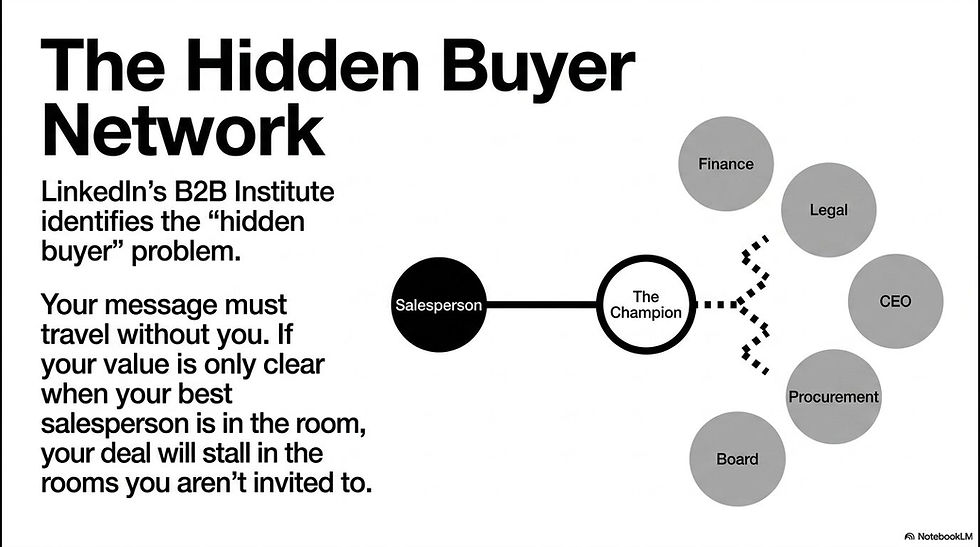
The hidden buyer problem: your message has to travel without you
In many B2B sales situations, the person on the call is not the only person involved in the decision.
There may be owners, executives, department heads, finance leaders, procurement teams, legal advisors, operational managers, board members, or outside consultants influencing the outcome.
Some of these people will never speak to your salesperson.
LinkedIn’s B2B Institute describes this as the “hidden buyer” problem: many influential stakeholders in the buying group do not leave obvious marketing or sales signals, even though they shape the purchase decision behind the scenes.
That matters because your sales message has to travel.
Your contact may understand the value after the call, but can they explain it clearly to the rest of the team?
Can they explain why this matters now?
Can they explain why your company is different?
Can they defend the investment?
Can they answer the obvious objections?
Can they share proof that builds confidence?
If the answer is no, the deal can stall even after a good sales meeting.
The salesperson did their job in the room.
The brand failed outside the room.
This is why content, case studies, clear service pages, strategic messaging, and proof assets matter. They help your internal champion carry the argument when you are not there.
Your brand has to be understandable without you.
If your message only works when your best salesperson is in the meeting, it is not strong enough yet.
Five brand assets that make sales easier
The solution is not to make the brand louder.
The solution is to make the brand more useful.
A sales-supporting brand gives buyers and sales teams the assets they need to create understanding, trust, and momentum.

Here are five assets that matter.
1. Clear positioning
Positioning defines where your company fits in the market and why buyers should care.
It answers questions like:
Who are we built for?
What problem do we solve?
What situation makes us especially valuable?
What makes our approach different?
What should buyers believe about us?
Without clear positioning, the market is forced to guess.
That creates inconsistent sales conversations, weak referrals, poor-fit leads, and price-based comparisons.
Clear positioning gives sales a stronger starting point.
2. A sharper offer structure
A confusing offer creates friction.
If prospects do not know where to start, what is included, what level of engagement fits them, or how the service connects to their problem, the sales process becomes heavier than it needs to be.
The offer does not need to be simplistic.
But it does need to be understandable.
A clear offer helps buyers self-identify. It helps them see which service is relevant. It helps them understand the value of the engagement before asking for a proposal.
This is where strategic growth work becomes useful. JAXONLABS’ Strategic Growth Blueprint connects business model, positioning, market opportunity, customer experience, execution planning, and practical prioritization into a clearer roadmap for growth.
That kind of clarity supports both leadership and sales.
3. Proof that matches the buyer’s concern
Not all proof is equal.
A testimonial may create trust. A case study may create confidence. A process explanation may reduce uncertainty. A before-and-after example may show transformation. A strong point of view may demonstrate expertise.
The key is matching proof to buyer concerns.
If the buyer is worried about risk, show credibility.
If the buyer is worried about cost, show business impact.
If the buyer is worried about complexity, show process.
If the buyer is worried about fit, show similar situations.
That is exactly where content becomes sales enablement.
4. A sales-ready website
A website should not just inform.
It should prepare.
It should help the buyer understand the company, qualify the fit, see the proof, answer common questions, and take the next step.
A weak website forces sales to do too much education.
A strong website allows sales to go deeper faster.
The website should support the buyer’s actual decision journey. That includes clear service pages, strong calls to action, relevant proof, helpful articles, direct messaging, internal links, and a structure that reflects how prospects think.
This also supports search visibility. Google’s guidance continues to emphasize helpful, reliable, people-first content rather than content created mainly to manipulate rankings.
For companies trying to rank in search and be understood by AI systems, the same principle applies: useful, clear, structured content wins over vague volume.
5. Leadership alignment
If leadership is unclear, sales and marketing will usually be unclear too.
The market often feels the confusion that starts inside the company.
One leader thinks the company should pursue enterprise buyers. Another wants volume. One person emphasizes premium expertise. Another wants to compete on speed. One team sells one version of the company. Another team describes something different.
That misalignment eventually reaches the customer.
Sales feels it first because sales has to translate the confusion into a conversation.
This is where executive clarity matters. JAXONLABS’ Founder & Executive Clarity Coaching is designed for founders, owners, and executives who need clearer priorities, stronger decisions, and better strategic focus.
Sales performance often improves when leadership gets clearer about the direction of the business.
The JAXONLABS Brand-to-Sales Clarity Check
If you want to diagnose whether your sales problem is actually a brand problem, start with these questions.

1. Can prospects understand what you do in under 30 seconds?
Not every detail. Not every service. Not every nuance.
But can they quickly understand the category, the problem, the audience, and the value?
If not, the sales team is likely carrying too much explanation.
2. Does your brand name the problem your buyer already feels?
Good messaging does not just describe services.
It describes recognizable pain.
The buyer should feel, “That is exactly what we are dealing with.”
3. Is your offer easy to understand and easy to enter?
A buyer should know what to ask about first.
If the entry point is unclear, the sales process starts with confusion.
4. Do you have proof that supports the sale before the meeting?
Case studies, testimonials, examples, process pages, articles, videos, and reviews help buyers build confidence before they talk to you.
Without proof, sales has to build all trust manually.
5. Can your message travel to people who never meet you?
This may be the most important question.
Can your buyer explain your value to their boss, partner, board, procurement team, or internal stakeholders?
If they cannot, the deal depends too heavily on you being present.
How to fix the problem
If sales conversations are harder than they should be, do not start by blaming the sales team.
Start by examining the environment sales is operating inside.
Look at the website.
Look at the service pages.
Look at the offer structure.
Look at the case studies.
Look at the proposal.
Look at the sales deck.
Look at the social content.
Look at the way referrals describe the company.
Look at the way leadership explains the company internally.
Then ask one hard question:
Are all of these assets making the buyer more confident before the conversation, or are they leaving too much work for sales to clean up later?
The fix usually requires a few practical moves.
Clarify the positioning.
Define the buyer and the problem more sharply.
Make the offer easier to understand.
Build proof around the concerns buyers actually have.
Improve the website so it supports decision-making, not just presentation.
Create content that answers real buyer questions.
Align leadership around the message and direction.
Turn the strategy into assets sales can actually use.
That is where brand strategy becomes business infrastructure.
It connects the market-facing message to the internal decisions that shape growth.

Final thought: sales should not have to create clarity from scratch
Sales teams should sell.
They should diagnose, qualify, guide, challenge, advise, and help buyers make confident decisions.
They should not have to rebuild the company’s positioning in every meeting.
They should not have to explain the basics from scratch every time.
They should not have to fight unclear messaging, vague offers, weak proof, and a website that does not support the conversation.
When sales is constantly creating clarity in real time, the brand is not doing enough work.
That is the real issue.
A stronger brand does not make sales unnecessary.
It makes sales more effective.
It helps the right buyers understand the company sooner, trust the offer faster, and enter the conversation with better context.
If every sales conversation starts at zero, your company may not need a harder sales push.
It may need a clearer brand foundation.


