
AI for Small Businesses - 2025 Snapshot & 5 Year Outlook

Updated: Aug 29
From AI Tools to AI Operating Systems
AI is no longer sitting on the edge of small business operations.
It is moving into the middle.
For the last few years, most small businesses used AI in simple ways: writing emails, summarizing notes, generating social posts, building images, drafting job descriptions, creating outlines, or speeding up admin work.
That phase mattered. It helped owners and teams understand what the technology could do.
But the bigger shift is now happening.
AI is moving from individual tools into connected workflows. It is being embedded inside the platforms small businesses already use for bookkeeping, sales, marketing, customer service, scheduling, reporting, and internal communication.
That changes the conversation.

The advantage is no longer simply knowing how to use ChatGPT, Copilot, Gemini, Claude, Canva, or automation tools. The advantage is knowing where AI belongs inside the business.
The companies that benefit most over the next five years will not be the ones that chase every new tool. They will be the ones that build AI into clear workflows, clean data, practical systems, and better decision-making.
That is where the real leverage is.
For business owners, founders, and leadership teams, AI should not be treated as a novelty. It should be treated as part of the operating system of the company.
TL;DR
Key Point | What It Means for Small Businesses |
AI is becoming infrastructure | AI is increasingly built into the software companies already use. |
Tools are not the strategy | The real value comes from workflow design, clean data, team adoption, and measurement. |
Agents are the next wave | AI is beginning to move from answering questions to helping complete defined business tasks. |
Governance matters earlier | As AI connects to email, files, CRMs, finance tools, and customer data, permissions and review processes become critical. |
AI search is changing visibility | Customers are using AI-powered search to compare options, summarize providers, and make decisions. |
Brand clarity becomes more important | AI can scale content, but it cannot fix unclear positioning or weak offers. |
The winning pattern is practical | Start with one workflow, measure time saved, improve the system, then scale what works. |
By 2030, the strongest small businesses will use AI to move faster, reduce waste, improve customer experience, strengthen decision-making, and protect margins.
The winning pattern is simple: start with strategy, clean up the workflow, pilot one use case, measure the result, then scale what actually works.
1. Where Small Businesses Stand Now
Small businesses are past the point of asking whether AI matters.
The better question is where it belongs.
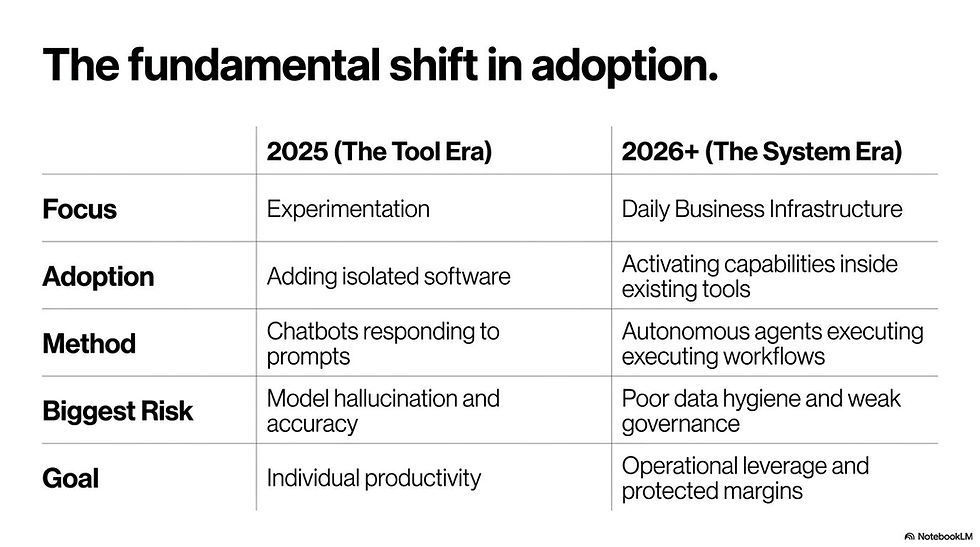
In 2025, many companies tested AI through writing assistants, design platforms, chatbots, meeting summaries, spreadsheet tools, bookkeeping features, and simple automations. In 2026, the conversation has shifted.
AI is increasingly being built directly into the tools companies already depend on. This includes productivity suites, accounting platforms, CRMs, ecommerce systems, customer support tools, design platforms, and scheduling software.
That matters because AI adoption is becoming less about adding more software and more about activating capability inside existing systems.
Microsoft positions Copilot as AI built into familiar Microsoft 365 apps, and Google’s search guidance now directly addresses AI Overviews and AI Mode from a website owner’s perspective.
Anthropic has also moved toward small business workflows with Claude for Small Business, which has been reported as connecting Claude to tools such as QuickBooks, PayPal, HubSpot, Canva, DocuSign, Google Workspace, and Microsoft 365.
That is the important signal.
AI is not just becoming more powerful. It is becoming more connected.
For small businesses, this creates a serious opportunity. But it also creates a new kind of risk.
If the underlying workflow is messy, AI can speed up the mess. If the data is unreliable, AI can produce confident but weak recommendations. If the offer is unclear, AI can create more content that still fails to convert.
This is why AI strategy has to start with business clarity.
Before adding new tools, leadership teams need to understand where the business is going, what workflows matter, what problems are worth solving, and what decisions need better support.
A clear Strategic Growth Blueprint can help separate useful AI opportunities from expensive distractions.
2. The AI Maturity Ladder for Small Businesses
Not every business is at the same stage.
Some are still experimenting. Some have a few useful workflows. Others are starting to connect AI across sales, finance, marketing, and operations.
The mistake is assuming every business should jump straight to advanced automation.
They should not.
AI maturity should build in stages.
Stage | What It Looks Like | Business Benefit | Common Risk |
1. Experimentation | Staff use AI individually for writing, research, summaries, and admin support. | Quick productivity gains. | Inconsistent quality and no shared standards. |
2. Workflow Support | AI helps with repeatable tasks like follow-ups, reports, quotes, outlines, and meeting notes. | Time saved on recurring work. | Weak review habits or unclear ownership. |
3. Connected Systems | AI connects to CRM, finance, marketing, website, ecommerce, or scheduling tools. | Better handoffs and fewer manual steps. | Messy data creates unreliable outputs. |
4. Supervised Agents | AI completes defined steps with human approval. | Faster execution across multi-step workflows. | Poor permissions or unclear approval rules. |
5. Operating Layer | AI supports reporting, decision-making, customer experience, and strategic execution across the business. | Stronger margins, faster decisions, better scalability. | Governance gaps and over-reliance on automation. |
The goal is not to reach the most advanced stage as fast as possible.
The goal is to move through the stages responsibly.
A company with weak data, unclear roles, and scattered processes should not start with agents. It should start with workflow clarity.
That is where Growth Systems Development becomes highly relevant. AI works best when lead generation, sales follow-up, client onboarding, reporting, content production, and execution are mapped into a usable operating system.
3. What Changed Since This Article Was First Written
The original conversation around AI for small businesses focused heavily on productivity.
That is still important, but three developments have moved faster than expected.

AI agents are becoming practical
The biggest development is the rise of AI agents.
An AI agent is different from a basic chatbot. A chatbot responds to a prompt. An agent can be given a goal, connected to business tools, and asked to complete steps within defined permissions.
In practical terms, that means AI can begin supporting work such as:
Agent-Supported Task | Practical Business Use |
Invoice follow-up | Draft reminders, identify overdue accounts, prepare payment summaries. |
Customer conversation summaries | Summarize calls, emails, or chats into next steps. |
Sales preparation | Prepare prospect briefs, draft outreach, summarize CRM activity. |
Marketing workflows | Draft campaign briefs, content outlines, ad variations, and reporting summaries. |
Meeting support | Prepare agendas, capture action items, and draft follow-up notes. |
Support routing | Triage customer requests and send them to the right person. |
Reporting | Pull together weekly or monthly performance summaries. |
Admin coordination | Prepare internal updates, task lists, and recurring workflow reminders. |
This does not mean businesses should hand everything over to AI.
The better model is supervised automation.
AI handles repeatable work. Humans review, approve, adjust, and make judgment calls.
That is where the value starts to compound.
Governance now matters earlier
When AI was mostly used for writing and brainstorming, the risk was limited.
Now that AI can connect to email, calendars, documents, financial tools, CRMs, ecommerce platforms, and customer records, governance has become a much bigger issue.
Small businesses need to answer basic questions.
Governance Question | Why It Matters |
Who is allowed to use AI tools? | Prevents uncontrolled access and inconsistent use. |
What information can be entered into AI tools? | Protects client, employee, financial, and proprietary data. |
Which tools are approved? | Reduces risk from random or insecure platforms. |
What requires human review? | Prevents sensitive or inaccurate output from going live. |
Who owns AI-related decisions? | Creates accountability. |
How are errors reported? | Helps the business improve the system over time. |
These questions may sound like enterprise concerns, but they are becoming small business concerns too.
A ten-person business with messy permissions and customer data exposed across too many tools can create problems quickly.
Governance does not need to be complicated. It just needs to be clear.
AI search is changing visibility
Search is also changing.
Google has published guidance for how AI features such as AI Overviews and AI Mode work from a website owner’s perspective. Its newer guidance for generative AI search also says SEO best practices still matter because these experiences are rooted in Google’s broader Search ranking and quality systems.
This is important for small businesses.
Customers are no longer only typing short keywords into search engines. They are asking longer, more specific questions. They are comparing options. They are using AI tools to summarize markets, vendors, services, products, and local providers.
That means businesses need to create content that is useful, credible, specific, and easy for both people and AI systems to understand.
For companies that want to be found when customers are researching decisions, Search Visibility & Content Authority is no longer just about keywords. It is about building a stronger content and authority system.
4. AI Use Cases by Business Function
Most small businesses do not need more tools.
They need better systems.
This is where many AI conversations go wrong. Owners see a new platform, a new demo, or a new AI feature and immediately ask, “Should we use this?”
That is the wrong starting point.

The better questions are:
Where are we losing time?
Where are we losing leads?
Where are errors happening?
Where are customers waiting too long?
Where is the owner still doing work that should be systemized?
Where does the team need better information to make decisions?
AI becomes useful when it is applied to a clear business problem.
Business Function | Best Early AI Use Case | What to Measure |
Sales | Lead research, outreach drafts, CRM summaries, follow-up reminders. | Response time, meetings booked, follow-up completion rate. |
Marketing | Content outlines, campaign briefs, ad variations, blog refreshes, social repurposing. | Content velocity, engagement, qualified traffic, conversion rate. |
Customer Service | FAQ responses, ticket summaries, sentiment routing, after-hours triage. | Response time, resolution time, customer satisfaction. |
Finance | Invoice follow-up, receipt processing, cash-flow summaries, anomaly detection. | Hours saved, overdue invoices, reporting speed, error reduction. |
Operations | SOP drafting, task handoffs, scheduling support, workflow documentation. | Completion rate, handoff errors, time saved. |
HR and Team Support | Job descriptions, onboarding checklists, policy summaries, training materials. | Hiring speed, onboarding consistency, team adoption. |
Leadership | Decision briefs, meeting summaries, performance reports, strategic scenario planning. | Decision speed, clarity, accountability, execution follow-through. |
Website and Conversion | Chat support, form qualification, content recommendations, customer journey analysis. | Lead quality, form completion rate, conversion rate, bounce rate. |
The tool is secondary.
The workflow comes first.
5. Sector Outlook: Where AI Creates Practical Value
Different industries will benefit from AI in different ways.
The best use case for an accounting firm is not the same as the best use case for a contractor, CPG brand, or professional services company.
The table below gives a practical view of where AI can create value first.
Business Type | Best Early AI Use Case | Strategic Opportunity | What to Avoid |
Accounting and advisory firms | Reconciliation support, document intake, monthly summaries, client follow-ups. | Shift capacity into advisory, cash-flow support, and owner reporting. | Treating AI only as a cost-cutting tool. |
Trades and home-service companies | Lead capture, quoting, scheduling, job notes, review requests. | Faster response times and stronger margin control. | Automating a messy customer journey. |
CPG brands | Demand forecasting, product copy testing, customer review analysis, ad variation testing. | Better inventory decisions, stronger positioning, and smarter campaigns. | Producing more content without clearer brand strategy. |
Professional services | Proposal drafts, onboarding materials, meeting summaries, internal knowledge management. | More consistent delivery and stronger packaging of expertise. | Letting AI flatten the firm’s point of view. |
Local service businesses | FAQs, booking support, review responses, customer education, local content. | Better conversion from existing demand. | Using generic content that does not build trust. |
Ecommerce businesses | Product descriptions, abandoned cart flows, segmentation, customer service, review analysis. | Better lifecycle marketing and customer experience. | Relying on AI copy without testing actual buyer behaviour. |
6. Financial Services and Accounting Firms
Accounting firms, bookkeeping businesses, financial advisors, and professional service providers have some of the clearest AI opportunities.
The work often includes structured data, repeatable workflows, document review, communication, reconciliation, reporting, and advisory conversations. These are all areas where AI can support meaningful time savings.
Pain Point | AI-Supported Fix | Strategic Upside |
Manual transaction review | Categorization support, anomaly flags, document intake. | Less time spent on low-value admin. |
Slow monthly reporting | Draft summaries, variance notes, dashboard explanations. | Faster client conversations. |
Repetitive client emails | Drafted reminders, follow-ups, and plain-English explanations. | More consistent communication. |
Limited advisory capacity | AI-assisted analysis and report preparation. | More time for higher-value advisory. |
Disorganized client records | File summaries, document extraction, structured intake. | Cleaner workflow and better service delivery. |
The more strategic opportunity is not just doing the same work faster.
The opportunity is using saved time to create higher-value advisory services.
For example, if a bookkeeping firm reduces manual admin work, that capacity can be redirected into monthly profit reviews, cash-flow summaries, pricing analysis, or owner advisory sessions.
That is where AI becomes a business model opportunity, not just a productivity tool.
For service firms turning AI-driven efficiency into stronger offers, Go-To-Market & Offer Strategy can help clarify what is being sold, who it serves, why it matters, and how to package it in a way the market understands.
Five-year outlook for financial firms
By 2030, more firms will move toward continuous accounting, real-time reporting, and proactive advisory.
The traditional month-end close may not disappear completely, but it will become less manual and less delayed. AI will help identify issues earlier, summarize patterns faster, and support better client conversations.
The firms that win will be the ones that combine automation with judgment.
AI can prepare the numbers. Humans still need to explain what the numbers mean.
7. Trades and Home-Service Companies
Trades and home-service companies have a different AI opportunity.
The value is not in fancy strategy documents. The value is in speed, coordination, and follow-through.
For contractors, plumbers, electricians, landscapers, HVAC companies, roofers, builders, renovation firms, and maintenance businesses, small workflow improvements can create real revenue impact.
Pain Point | AI-Supported Fix | Business Impact |
Missed after-hours leads | AI chat, form qualification, call summaries, next-step routing. | More opportunities captured. |
Slow quoting | Draft estimates, scope summaries, pricing references, customer-ready proposals. | Faster response and better conversion. |
Poor job documentation | Voice notes turned into job summaries, invoices, and follow-up emails. | Cleaner records and fewer admin delays. |
Weak follow-up | Automated reminders, review requests, maintenance prompts. | Better retention and reputation. |
Scheduling friction | Crew availability summaries, route planning support, job handoff notes. | Less wasted time and fewer missed details. |
The biggest opportunity is faster response time.
Many customers do not wait long. If they fill out a form, call a business, or send a message and do not hear back quickly, they move on.
AI can help reduce that gap.
But again, the system matters. If lead sources, quoting, scheduling, customer records, and follow-up are disconnected, AI will only solve part of the problem.
The best use of AI in trades is not replacing the team. It is helping the team respond faster, stay organized, and protect margin.
Five-year outlook for trades
By 2030, many trades businesses will use AI-supported dispatch, quoting, customer communication, and job documentation as normal operating practice.
Field teams will speak job notes into mobile devices. Those notes will become invoices, customer summaries, warranty records, and follow-up emails.
Photos from job sites may help identify issues, document progress, and support estimates.
The most advanced operators will connect marketing, estimating, scheduling, invoicing, reviews, and reporting into one practical growth system.
That is where AI becomes a competitive advantage.
8. Consumer Packaged Goods Brands
CPG brands have a strong AI opportunity because they deal with many moving parts.
Product development, inventory, demand forecasting, retail relationships, ecommerce, content, packaging, customer feedback, advertising, and margin management all create data.
The challenge is that many small CPG companies do not have the systems to use that data well.
Challenge | AI-Supported Play | Strategic Value |
Demand swings | Forecasting support using sales history, promotions, seasonality, and customer behaviour. | Better inventory planning. |
Tight margins | Pricing analysis, promotion review, product mix insights. | Stronger margin management. |
Content demands | Product descriptions, email drafts, ad variations, retail support materials. | Faster campaign execution. |
Customer feedback | Review analysis, sentiment summaries, objection tracking. | Better messaging and product education. |
New product decisions | Trend research, concept testing, social listening, customer segmentation. | Faster learning before larger bets. |
But CPG brands need to be careful.
AI can create a lot of content quickly, but more content does not automatically create a stronger brand.
If the brand position is unclear, AI will multiply the confusion.
A snack brand, beverage company, wellness product, apparel brand, or specialty food business needs to know what it stands for, who it serves, why customers choose it, and how it should communicate value.
That is why Brand Clarity & Positioning becomes more important as AI adoption grows.
AI can help scale expression. It cannot replace strategic clarity.
Five-year outlook for CPG
By 2030, smaller CPG brands will use AI to test ideas faster, understand customer demand earlier, and adjust campaigns more intelligently.
Retail sell-through, ecommerce behaviour, customer reviews, social engagement, and seasonal trends will become more connected.
The brands that win will not simply generate more product content. They will use
AI to understand demand, strengthen positioning, improve distribution decisions, and communicate with more precision.
9. Why Brand Clarity Matters More in an AI-Driven Market
AI makes it easier to create.
That is both useful and dangerous.
A business can now create articles, ads, email campaigns, social posts, landing page copy, product descriptions, proposals, scripts, images, videos, and sales materials much faster than before.
But speed does not guarantee quality.
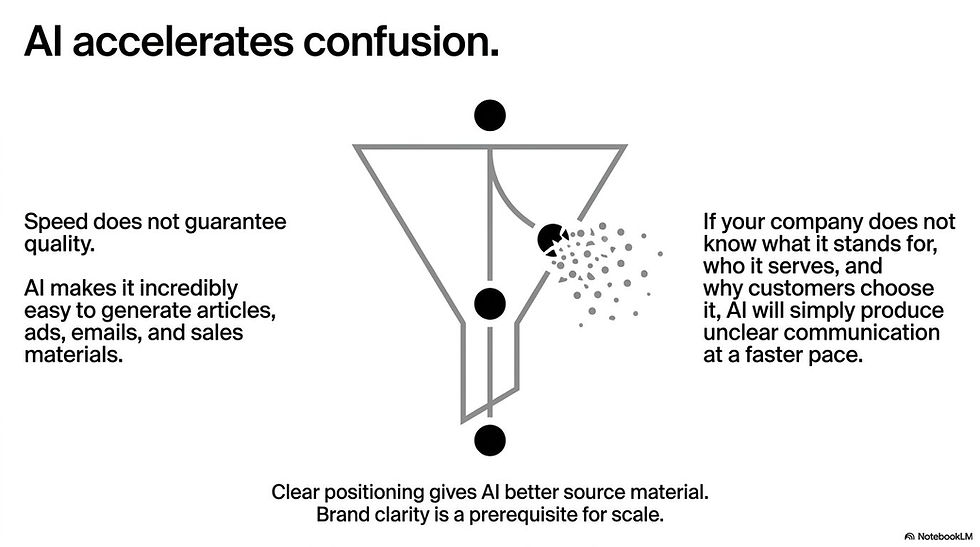
If the company does not know what it stands for, who it serves, why customers choose it, or how its offer should be explained, AI will simply help produce more unclear communication at a faster pace.
That is the hidden risk.
AI can accelerate confusion.
Without Brand Clarity | With Brand Clarity |
AI creates generic content. | AI helps scale a defined point of view. |
Messaging changes from platform to platform. | Messaging stays consistent across touchpoints. |
Offers feel vague or interchangeable. | Offers are easier to understand and compare. |
Content volume increases, but conversion does not. | Content supports trust, education, and buying decisions. |
Teams prompt AI from memory. | Teams use clear source material, positioning, and proof. |
This is why brand strategy becomes more important, not less.
Clear positioning gives AI better source material. Clear messaging keeps communication consistent. Clear offers make campaigns easier to build. Clear proof makes websites, sales conversations, and content more persuasive.
The companies that benefit most from AI content tools will be the ones with strong inputs.
They will have a clear point of view, a defined audience, a strong offer, credible proof, and a consistent message.
Without that, AI becomes a content machine with no strategic direction.
10. AI Search and the Future of Website Visibility
Search is changing from keywords to conversations.
That does not mean SEO is dead. It means shallow SEO is getting weaker.
Google’s guidance says generative AI search is still rooted in core search systems and that foundational SEO best practices continue to matter. Google also warns that using AI to generate many pages without adding value can violate its spam policies around scaled content abuse.

Customers are asking more complex questions:
Who is the best fit for my situation?
What should I consider before hiring this type of company?
How much should this cost?
What are the risks?
What is the difference between these options?
Which provider seems credible?
Which company understands my industry?
AI-powered search experiences are built to answer these kinds of questions more directly. That means businesses need content that demonstrates expertise, answers real customer questions, and clearly explains the company’s point of view.
Old SEO Mindset | AI Search Visibility Mindset |
Target a keyword. | Answer a real customer question. |
Write more posts. | Build stronger topical authority. |
Optimize metadata only. | Improve content quality, structure, internal links, and proof. |
Chase rankings. | Help customers and AI systems understand the business clearly. |
Publish generic content. | Publish specific, experience-based, useful content. |
This is especially important for professional services, consulting firms, local service providers, niche manufacturers, specialized contractors, and B2B companies.
A thin website with vague service descriptions will not be enough.
Small businesses should focus on:
Website Asset | Why It Matters |
Clear service pages | Helps customers understand what you do and whether you are the right fit. |
Strong internal linking | Helps users and search systems understand the relationship between ideas and services. |
Useful educational content | Builds trust before the sales conversation. |
Specific industry examples | Shows relevance and experience. |
Real proof and case studies | Makes claims more credible. |
Author credibility | Helps reinforce trust and expertise. |
Clean metadata | Improves clarity in search results. |
Crawlable structure | Helps search engines access and understand the site. |
Strong contact paths | Turns interest into qualified conversations. |
In other words, AI search rewards the same thing customers reward: clarity.
A strong Search Visibility & Content Authority system helps turn expertise into useful content that can build trust, improve discovery, and support long-term authority.

11. The Practical AI Roadmap for Small Businesses
Small businesses do not need a 50-page AI transformation plan.
They need a practical roadmap.
Phase | Key Action | Example Metrics |
1. Map | Identify repetitive work, workflow friction, delays, and error-prone tasks. | Time lost, error rate, response delays, owner bottlenecks. |
2. Prioritize | Choose one workflow where improvement would create visible value. | Revenue impact, time saved, customer experience impact. |
3. Pilot | Test one narrow AI use case with a clear owner and review process. | Hours saved, output quality, adoption rate. |
4. Integrate | Build the winning workflow into SOPs, templates, and team habits. | SOP updates, completion rate, team consistency. |
5. Govern | Define approved tools, data rules, review standards, and accountability. | Policy adoption, approval compliance, incidents avoided. |
6. Scale | Expand into connected systems and higher-value use cases. | Margin improvement, faster decisions, stronger reporting. |
Step 1: Map the business
Start by identifying repetitive, time-consuming, error-prone, or high-friction workflows.
Look at sales follow-up, customer service, quoting, scheduling, bookkeeping, reporting, content production, proposal development, inventory planning, onboarding, and internal communication.
The goal is not to automate everything.
The goal is to find the work where improvement would actually matter.
Step 2: Choose one pilot
Pick one use case.
Do not start with ten.
A good pilot should be narrow, measurable, and low risk.
Pilot Idea | Why It Works |
Reduce time spent writing follow-up emails. | Easy to test and measure. |
Improve speed of quote preparation. | Direct impact on conversion. |
Summarize customer inquiries. | Reduces admin load and improves handoffs. |
Draft weekly performance reports. | Improves leadership visibility. |
Turn meeting notes into action items. | Improves accountability. |
Categorize incoming leads. | Helps sales prioritize faster. |
Generate review request emails. | Supports reputation and local visibility. |
Prepare monthly financial summaries. | Helps owners understand the business faster. |
The best early metric is often time saved.
Revenue impact matters, but time saved is easier to measure at the beginning.
Step 3: Create the workflow
Do not just tell the team to “use AI.”
Define the workflow.
What triggers the task?
What information does AI need?
What output should it produce?
Who reviews it?
Where does the final version go?
What should never be automated?
What does success look like?
This is where AI moves from novelty to operating discipline.
Step 4: Train the team
Most AI failures are not technology failures.
They are adoption failures.
The team needs to understand what the tool is for, how to use it, what good output looks like, and where human review is required.
Prompting matters, but workflow design matters more.
A good prompt inside a bad process will not save the business.
Step 5: Create governance
Every company using AI should have a simple policy.
Policy Area | What to Define |
Approved tools | Which AI tools are allowed for business use. |
Data rules | What information can and cannot be entered. |
Review standards | What outputs require human approval. |
Client information | How client data is protected. |
Financial information | How sensitive financial data is handled. |
Content standards | What must be reviewed before publishing. |
Ownership | Who is accountable for AI workflows. |
Error reporting | How mistakes are documented and corrected. |
This does not need to be bureaucratic.
It just needs to be clear.
Step 6: Scale what works
After a pilot proves useful, build it into the operating system.
Add it to SOPs. Train the team. Track performance. Improve the workflow. Then move to the next use case.
This is how AI adoption becomes compounding instead of chaotic.
12. The 2030 Outlook: Five Trends That Will Shape Small Business AI
Trend | What It Means | Strategic Implication |
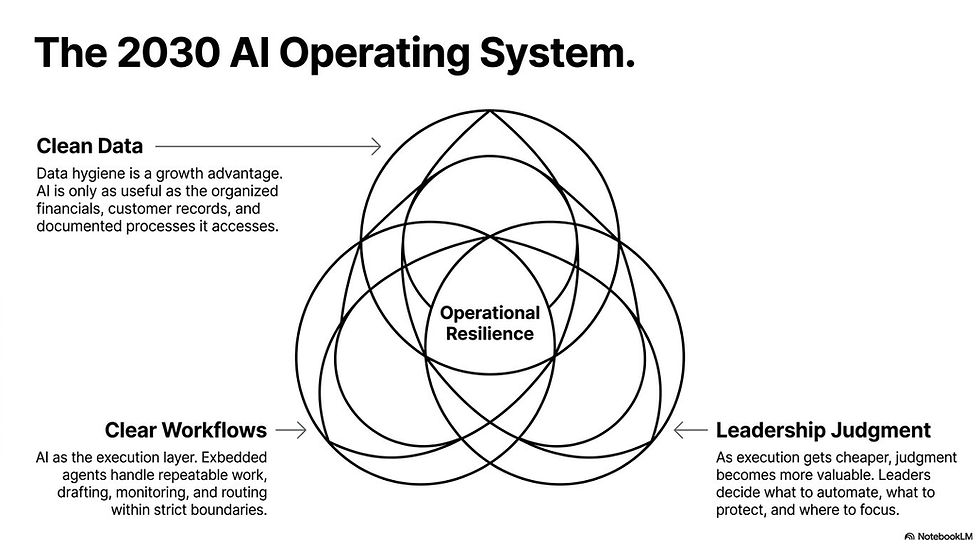
AI moves from assistant to operating layer | AI will sit inside finance, CRM, marketing, scheduling, HR, customer service, ecommerce, and reporting tools. | Businesses need better systems, not just better prompts. |
Agents handle more repeatable work | AI will prepare, draft, monitor, summarize, route, and recommend. | Leaders must decide what to delegate and what to keep human. |
Data quality becomes a competitive advantage | Clean records, documented workflows, and organized reporting will matter more. | Data hygiene becomes part of growth strategy. |
Search visibility becomes more conversational | Customers will ask AI systems for comparisons, recommendations, and summaries. | Useful, specific, credible content becomes more valuable. |
Leadership judgment becomes more important | Execution gets cheaper, but prioritization becomes harder. | Strategic clarity becomes the real constraint. |
1. AI moves from assistant to operating layer
AI will increasingly sit inside finance, CRM, marketing, scheduling, HR, customer service, ecommerce, and reporting tools.
Small businesses will not always think of themselves as “using AI.” They will simply use modern business software that has AI built in.
The question will shift from “Should we use AI?” to “Are our systems good enough to benefit from it?”
2. Agents handle more repeatable work
AI agents will take on more repeatable business tasks.
This does not mean fully autonomous companies. It means supervised workflows where AI prepares, drafts, monitors, summarizes, and recommends.
Humans will still make judgment calls, manage relationships, approve sensitive decisions, and handle strategic tradeoffs.
The businesses that win will know what to delegate to AI and what to keep human.
3. Data quality becomes a competitive advantage
AI is only as useful as the information it can access.
Companies with clean customer records, organized financials, documented processes, clear service categories, and reliable reporting will get more value from AI.
Companies with scattered spreadsheets, inconsistent naming, incomplete CRM records, and poor documentation will struggle.
Data hygiene will become a growth advantage.
4. Search visibility becomes more conversational
Customers will continue asking AI systems for recommendations, comparisons, explanations, and summaries.
That means businesses need content that is clear, credible, and specific.
The future of search will not reward generic content farms. It will reward useful expertise, clear positioning, strong website structure, and trust-building content.
5. Leadership judgment becomes more valuable
As execution gets cheaper, judgment becomes more valuable.
AI can help produce more ideas, more content, more reports, and more analysis.
But it cannot decide what matters most for the business.
Leaders still need to make hard choices. They need to decide what to automate, what to protect, what to measure, what to ignore, and where the company should focus.
For founders and executives carrying too many decisions, Founder & Executive Clarity Coaching can provide a structured space to think through priorities, tradeoffs, opportunities, and next steps.
13. What Small Businesses Should Avoid
AI creates opportunity, but it also creates noise.
Small businesses should avoid five common mistakes.
Mistake | Why It Hurts | Better Approach |
Chasing tools before strategy | Creates subscriptions without leverage. | Start with the business problem. |
Automating broken workflows | Makes bad processes move faster. | Redesign the workflow first. |
Replacing judgment with output | AI can sound confident while being wrong. | Use AI to support thinking, not replace it. |
Producing content without clarity | More content does not mean stronger positioning. | Clarify brand, audience, offer, and proof first. |
Ignoring governance | Creates risk around data, permissions, and accountability. | Define simple rules early. |
Chasing tools before strategy
New tools are easy to buy.
Clear strategy is harder.
Before adopting another platform, clarify the business problem.
Otherwise, AI becomes another subscription instead of a source of leverage.
Automating broken workflows
AI should not be used to speed up a process that should be redesigned.
If the handoff is unclear, the data is messy, or the customer experience is weak, automation may make the problem harder to see.
Fix the workflow first.
Replacing judgment with output
AI can generate confident answers.
That does not mean the answers are right.
Use AI to support thinking, not replace it.
Producing content without clarity
More content is not a strategy.
If the brand, offer, audience, and message are unclear, AI-generated content can dilute trust instead of building it.
Ignoring governance
Even small businesses need rules.
The more AI connects to business systems, the more important permissions, privacy, review, and accountability become.
14. Final Thoughts: AI Is a Strategy Decision
AI is not just a technology decision.
It is a strategy decision.
It affects how the company sells, serves customers, manages information, builds content, supports teams, measures performance, and makes decisions.
The businesses that benefit most over the next five years will not be the ones that chase every new AI feature. They will be the ones that build clearer systems.
They will know where AI belongs.
They will clean up their workflows.
They will protect their data.
They will train their teams.
They will use AI to improve real business outcomes, not just create impressive demos.
For small businesses, the next competitive edge is not simply using AI. It is operationalizing AI in a way that makes the company faster, clearer, leaner, and more resilient.
That starts with clarity.
If your company is exploring how AI fits into your strategy, systems, content, website, or leadership decisions, JAXONLABS can help turn scattered experimentation into a practical operating advantage.


