
The FIFA Paradox: Brand, Controversy, and the World’s Shared Experience

FIFA may be one of the most complicated brands in the world.
Not because people struggle to understand what it does. They understand it almost immediately.
Football. Nations. Tournaments. Stadiums. Sponsors. Broadcasts. Flags. Anthems. Goals.
The complexity comes from everything else the brand carries.
FIFA represents joy and controversy. Belonging and exclusion. Tradition and technology. National pride and geopolitical tension. Human emotion and commercial machinery. The purity of a simple game and the weight of a global institution.
That is what makes FIFA such a useful brand case study.

The World Cup is not just a sports tournament. It is one of the last remaining global rituals. In a fragmented media environment, where culture is increasingly split across platforms, algorithms, interests, languages, and beliefs, the World Cup still creates a rare shared moment.
Billions of people do not simply consume the tournament. They gather around it. They remember where they were. They attach it to family, childhood, identity, heartbreak, hope, and national memory.
That kind of attention is almost impossible to manufacture.
It is also dangerous to take for granted.
The same institution that gives smaller countries a world stage is criticized for how it selects hosts, monetizes access, manages controversy, and expands the commercial footprint of the game.
The same tournament that claims to represent the world can become a reminder of who gets priced out, who gets overlooked, and who carries the cost of the spectacle.
This is the FIFA paradox.
The brand is powerful because the experience is bigger than the institution.
But the institution still shapes the experience.
FIFA Is Not Just a Sports Brand
Most brands compete for attention.
FIFA organizes attention.
That is a different kind of power.
The World Cup does not behave like ordinary content. It is not another campaign fighting for space in the feed.
It is anticipated years in advance. People organize travel around it. Cities prepare for it. Sponsors build global activations around it. Broadcasters reshape schedules around it. Families and friend groups create rituals around it.
For a few weeks, the tournament gives the world a common structure.
There are teams to follow, villains to debate, favourites to test, underdogs to adopt, and moments to remember. The game itself is simple enough for anyone to understand, but the meaning around it is layered with history, geography, politics, identity, economics, and emotion.

This is what makes the World Cup different from most sports properties.
It is not only watched.
It is inhabited.
A person may not care about FIFA as an organization. They may not know the executives, the governance structure, or the commercial model. They may even distrust the institution. But when their country plays, the abstraction disappears.
The tournament becomes personal.
That is brand gravity.
FIFA’s strongest asset is not a logo, slogan, or identity system. It is the emotional infrastructure of the World Cup itself. The tournament gives people a reason to feel connected to something larger than themselves.
That is what great brands do at their highest level.
They do not simply tell people what they stand for. They create moments people want to stand inside.

The Economics of Global Attention
The World Cup is one of the clearest examples of attention becoming an economic system.
FIFA does not just monetize football. It monetizes the world’s willingness to gather around football.
Broadcasting rights, sponsorship, licensing, hospitality, ticketing, and commercial partnerships all depend on the same underlying asset: shared attention at global scale.
That is why the 2026 World Cup matters so much from a brand and business perspective. The tournament has expanded to 48 teams and 104 matches across Canada, Mexico, and the United States.
More countries. More games. More host cities. More broadcast windows. More content. More sponsorship exposure. More ticketing opportunities. More data. More markets with a reason to care.

On one level, this is obvious growth logic.
A larger tournament creates more inventory.
But brand strategy is rarely that simple.
The better question is not whether FIFA can make the World Cup bigger. It already has. The better question is whether bigger will feel better, or whether the tournament risks becoming more expansive but less meaningful.
That question matters for any organization trying to scale.
Growth often begins as proof that the brand is working. More products, more markets, more audiences, more campaigns, more locations, more partners. But if expansion is not guided by a clear center of gravity, the brand can become diluted.
The thing that made people care in the first place gets stretched across too many touchpoints, too many offers, and too many competing priorities.
The World Cup has to protect the same balance.
Expansion can make the tournament more inclusive. It can introduce new nations, new stories, new audiences, and new emotional stakes. But if the tournament becomes too large, too slow, too commercialized, or too engineered, it can start to lose the scarcity and intensity that made it feel sacred.
That is the strategic tension inside FIFA’s growth model.
More reach is not automatically more meaning.
When Smaller Nations Get the World Stage
One of the most powerful parts of the World Cup is that it gives visibility to countries that rarely receive it.
Global attention is not evenly distributed.
Some countries live permanently in the center of the story because of economic power, political influence, military strength, population size, cultural exports, or media presence. Other countries appear only occasionally, often through crisis, conflict, disaster, or narrow stereotypes.
The World Cup changes that.
For smaller or less globally visible nations, qualification can become more than a sporting achievement. It can become a national identity moment. A flag appears on the global broadcast.
An anthem is heard by millions. A player becomes a symbol. A diaspora scattered across the world suddenly has a shared focal point.
This is where FIFA’s expansion becomes more interesting than the criticism around “more games” suggests.
A larger field can create more commercial inventory, but it can also create more emotional access. It gives more nations the opportunity to be seen through courage, skill, joy, and pride rather than through the limited narratives that often define them on the world stage.
That matters.
Because visibility changes perception.
A World Cup appearance does not solve a country’s economic, political, or social challenges. But it can give people a different way to see the nation. It can shift the emotional association. It can create tourism curiosity, national pride, international recognition, and a lasting story for the next generation.
For some countries, simply being there is part of the victory.
This is one of the reasons the World Cup remains so powerful even when FIFA is criticized. The institution may be flawed, but the stage still means something.
And when a smaller nation enters that stage, the tournament becomes less predictable, less closed, and more representative of the world it claims to gather.
A strong global brand does not only amplify the already powerful.
It creates room for new stories to enter the conversation.
Dynasties Give the Tournament Weight. Surprises Give It Life.
The World Cup works because it balances inherited meaning with the possibility of disruption.
The dynasties matter.
Brazil, Argentina, Germany, France, Italy, Spain, England, and other football powers arrive with history attached. Their shirts are symbols before the match begins. Their players inherit expectations from previous generations. Their victories feel like continuation. Their failures feel like rupture.
These countries give the tournament weight.
They create the mythology. They bring casual fans into the hierarchy of the sport.
They give the tournament a sense of historical consequence.
But if the World Cup were only about the dynasties, it would become predictable.
The surprises are what keep the tournament alive.
The underdog run. The breakout player. The favourite that collapses. The goalkeeper who refuses to concede. The country that was supposed to be grateful just to qualify but suddenly refuses to leave. These moments are not side stories. They are central to the emotional architecture of the World Cup.

Dynasties create anticipation.
Surprises create memory.
This is another lesson for brand builders. Strong ecosystems need both continuity and disruption. Too much tradition becomes stale. Too much novelty becomes incoherent. The most powerful brands know how to preserve what people recognize while still creating space for something unexpected to happen.
The World Cup does this better than almost any other global event.
People arrive for the familiar names.
They remember the moments nobody predicted.
Technology Is Changing the Ritual
Football has always had a relationship with uncertainty.
A close offside. A disputed handball. A referee’s decision. A goal that may or may not have crossed the line. For generations, these moments became part of the drama. Fans argued about them for years. Controversy became memory.
Technology is changing that relationship.
VAR, semi-automated offside technology, connected match balls, player tracking systems, AI-assisted analysis, and advanced broadcast infrastructure are moving football into a more measured era.
The intent is reasonable.
Make the game fairer. Reduce obvious mistakes. Support referees. Improve player performance. Give teams better information. Help broadcasters explain the match more clearly. Give fans more confidence that the result was legitimate.
But technology introduces a delicate brand problem.
Football is emotional because it flows. It is emotional because it feels immediate.
A goal is not just an event. It is a release. The stadium erupts. A family jumps off the couch. A city spills into the street. The moment matters because it happens all at once.

VAR changes that rhythm.
A goal is scored, but the celebration becomes provisional. The emotional release is suspended while people wait for confirmation. Accuracy may improve, but the feeling changes.
That does not make technology bad. It makes the design of technology important.
FIFA’s connected-ball technology is a perfect example. A match ball with embedded sensor capability can help identify the precise moment of contact and support decision-making on offside incidents. From a fairness perspective, that is valuable.
From a storytelling perspective, it is fascinating. The ball itself becomes part of the data system.
But it also shows how far the game has moved.
The simplest object in football is no longer simple.
The ball now carries information. The pitch is calibrated. The players are tracked. The match is interpreted through layers of data, video, analytics, and automated support.
This is the future of elite sport.
It is also a warning.
Technology should make the experience more trusted, not more distant. It should support the emotion of the game, not flatten it into process. The best technology disappears into the moment. The worst technology makes the moment feel managed.
That distinction matters far beyond football.
Many companies are racing to add AI, automation, analytics, and software into their operations. The opportunity is real. But technology only creates value when it improves the experience for the people inside the system.
Innovation is not the presence of tools.
Innovation is the improvement of the experience.
The World Cup as a Data Product
The World Cup is still presented as human drama, but underneath that drama is an increasingly sophisticated data system.
Players wear tracking units. Teams analyze workload, speed, spacing, pressing behavior, passing lanes, recovery patterns, and tactical structure. Broadcasters use advanced graphics to explain the match.
AI tools are being introduced to support performance analysis, operations, media workflows, and fan engagement.

The audience sees a goal.
A coach sees the movement that created it.
A broadcaster sees the replay package.
A sponsor sees the attention curve.
A host city sees the visitor movement.
FIFA sees the whole system.
That is what makes the World Cup so valuable as a brand ecosystem. A single moment creates different forms of value for different stakeholders. The same match can be a national memory, a media product, a commercial asset, a data source, a tourism driver, and a technology showcase.
This is where modern brand experience is headed.
The front end has to feel human.
The back end is becoming increasingly technical.
The risk is when the back end starts to dominate the front end. Data can improve performance, fairness, content, and operations. But data cannot become the soul of the experience.
The World Cup matters because people care before they calculate.
That has to remain true.

The Commercialization Problem
The World Cup has always been commercial.
That is not new.
What is changing is the scale, sophistication, and visibility of the commercial machine.
A larger tournament creates more opportunities to monetize attention. More matches mean more media windows.
More teams mean more national markets. More host cities mean more local activations. More global demand means more pricing power. More digital behavior means more data.
From a business perspective, this makes sense.
From a brand perspective, it is more complicated.
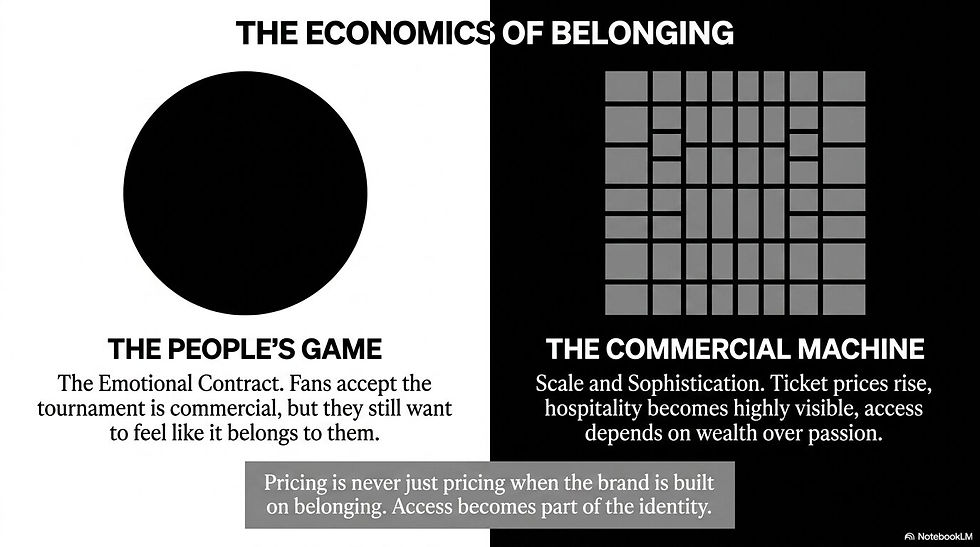
The World Cup is not just an entertainment product. It is tied to the idea of the people’s game. That creates an emotional contract. Fans accept that the tournament is commercial, but they still want to feel like it belongs to them.
When ticket prices rise sharply, when hospitality feels more visible than local supporters, when access depends more on wealth than passion, the contract changes.
A brand built on global belonging has to be careful when participation starts to feel exclusive.
This is not a simple argument against revenue. Global events require money, infrastructure, partners, broadcast systems, security, transportation, and operational excellence.
Commercial growth funds the spectacle.
But the economics still send a message.
Pricing is never just pricing when the brand is built on belonging.
Access becomes part of the identity.
That is the part leaders should pay attention to. Every organization has a version of this. Your pricing, onboarding, customer experience, service model, and communication style all tell people who the brand is really for.
A company can say it values customers.
The system proves whether that is true.
Host Cities and the Uneven Economics of the Spectacle
Hosting the World Cup is often framed as an opportunity.
And it is.
For countries and cities, the tournament can create global visibility, tourism activity, civic pride, infrastructure upgrades, local business activity, and a powerful place-branding moment.
To host a World Cup match is to become part of the global story.
But the economics are not always clean.
FIFA controls many of the most valuable commercial assets around the tournament, including broadcast rights, sponsorship rights, licensing, hospitality, and ticketing structures.
Host cities and governments often absorb major responsibilities around transportation, safety, traffic management, public space, infrastructure, and local coordination.

The result is a familiar tension in global events:
The brand at the center captures worldwide attention.
The host location carries much of the local complexity.
That does not mean hosting lacks value. It means the value has to be converted intentionally.
Attention by itself is not a strategy. A host city has to know what it wants the attention to become. More tourism after the event.
Better international reputation. Stronger civic confidence. Investment interest. Local business development. Infrastructure that remains useful. Stories that last longer than the final whistle.
The same is true for companies.
Visibility is only useful if there is a system behind it.
A brand can get the spotlight and still waste the moment. The organizations that benefit most from attention are the ones prepared to turn it into trust, relationships, and future demand.
The Controversy Is Part of the Brand
It is impossible to examine FIFA seriously without examining controversy.
The organization has faced sustained criticism around governance, corruption history, host selection, human rights, labor conditions, environmental impact, commercial pressure, and political influence.
These issues cannot be treated as separate from the brand.
They shape how the brand is experienced.
That does not mean the World Cup is only controversy. It clearly is not. For many people, it is joy, identity, family, memory, and pride. But mature brand analysis requires holding both truths at the same time.
FIFA creates one of the most powerful shared experiences in the world.
FIFA also carries institutional baggage that cannot be ignored.
This is the burden of owning something the world cares about.
As a brand grows, it loses the ability to separate what it says from how it operates. Host decisions, sponsor relationships, pricing models, sustainability claims, technology choices, and public responses all become part of the same story.
At FIFA’s scale, there is no backstage.

The spectacle and the system are connected.
This is why the brand remains fascinating. FIFA’s emotional product is stronger than its institutional reputation. People may criticize the organization and still love the tournament.
They may question the governance and still cry when their country scores. They may resent the commercial machine and still feel pulled into the ritual.
That separation is rare.
But it is not unlimited.
If the institution keeps placing too much pressure on the experience, the emotional buffer can weaken. Fans may still watch, but they may watch with more cynicism.
They may still care, but with less innocence. They may still gather, but with more awareness of the machine behind the magic.
That is the risk.
The World Cup can survive controversy.
It cannot survive losing its emotional center.
Why the Brand Still Works
The FIFA brand still works because football gives people something the institution itself could never manufacture on its own.
Belonging.
A reason to gather.
A story larger than the individual.
A way to see your country in symbolic form.
A way to participate in a global moment without needing to explain why it matters.
This is why the World Cup keeps pulling people back in.
The tournament activates identity at multiple levels. Personal memory. Family tradition. National pride. Regional rivalry. Diaspora connection. Sporting admiration. Cultural curiosity.
Even people who do not follow football closely can understand when something important is happening.
That is the power of a simple game carrying enormous meaning.
FIFA benefits from that meaning.
But it does not fully own it.
The emotion belongs to the fans, players, countries, and communities that bring the tournament to life.
FIFA owns the platform. It owns the structure. It owns many of the commercial rights. But the meaning is co-created by the world.
That is what makes the brand both powerful and vulnerable.
When a brand depends on shared meaning, it has to respect the people who create that meaning.
What Brands and Leaders Can Learn From FIFA
FIFA may seem far removed from most organizations, but the lessons are surprisingly practical.
The first lesson is that brand is not just communication.
Brand is the experience people gather around.
Many companies think about brand through visuals, messaging, campaigns, websites, and content. Those things matter. But they are not the whole system. A brand becomes powerful when people know what experience it creates and why that experience matters.
This is where brand strategy has to go deeper than positioning. It has to define the meaning, structure, audience, promise, and operating logic behind the business.
The second lesson is that growth has to protect the core.
FIFA’s expansion creates more opportunity, but it also increases the risk of dilution. That same pattern shows up in companies all the time.
More offers. More channels. More customer segments. More content. More automation. More partnerships.
Growth can create strength, but only when the center holds.
The question is not just, “How do we make this bigger?”
The better question is, “What must remain true as this gets bigger?”

The third lesson is that technology has to serve trust.
VAR, connected balls, tracking systems, and AI tools can make football more accurate, more measurable, and more advanced. But if technology interrupts the emotional rhythm of the experience, people feel it.
Businesses face the same challenge with AI and automation. Tools should reduce friction, improve clarity, and strengthen decision-making. They should not create complexity for its own sake.
This is why companies need practical growth systems that connect strategy, tools, workflows, and customer experience.
The fourth lesson is that economics are part of the brand.
Pricing, access, hospitality, ticketing, and commercial partnerships are not just financial decisions.
They affect how people interpret the promise of the brand.
If a company claims to be accessible but behaves in a way that feels exclusive, people notice. If it claims to be premium but delivers inconsistency, people notice. If it claims to be innovative but creates friction, people notice.
The system always tells the truth eventually.
That is why brand and execution cannot be separated. Strong positioning has to be supported by operational choices, customer experience, leadership decisions, and economic logic.
For companies trying to connect ambition with action, a clear strategic growth blueprint can help turn ideas into a system that actually supports the brand.
The FIFA Paradox
FIFA’s brand is powerful because it owns the platform for one of the world’s rare shared experiences.
But that power comes with pressure.
The World Cup is no longer just a tournament. It is a global media product, a commercial engine, a political stage, a technology showcase, a tourism driver, a national identity platform, and a shared cultural ritual.
Every decision made around it either protects or distorts the meaning people attach to it.
That is the paradox.
The tournament works because it feels human.
The machine behind it keeps getting bigger.
FIFA’s challenge is to grow the platform without draining the emotion from it. To use technology without making the game feel over-managed. To create commercial value without making belonging feel exclusive. To welcome more countries without diluting the intensity.
To carry global attention without pretending controversy lives outside the brand.
This is what every powerful brand eventually has to confront.
The more people care, the more the details matter.
The World Cup still gives the world something extraordinary: a reason to look in the same direction. In a divided, fragmented, distracted culture, that is rare. For a few weeks, the world gathers around a ball, a flag, a shirt, a song, a player, a match, a possibility.

That is not just sport.
That is shared meaning.
And shared meaning is the highest form of brand power.
FIFA has built one of the most valuable brand ecosystems in history because it gives people a moment they want to return to. But the future of that brand depends on whether the institution can remember what made the moment powerful in the first place.
The magic was never the machine.
The magic was the world coming together around the game.


